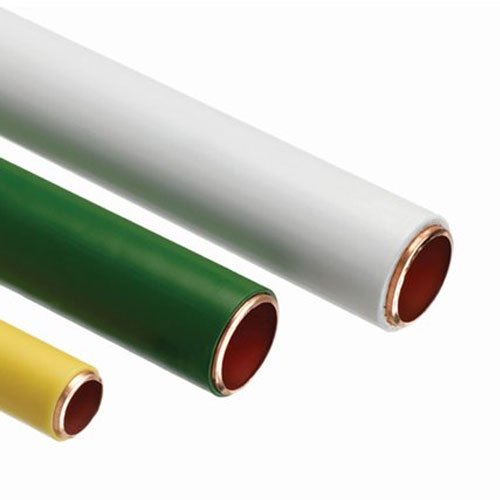
Copper Pipe with PVC Coating for Industrial & Building Services
Copper pipe with PVC coating is engineered for applications where standard copper piping requires enhanced external protection. The PVC coating acts as a durable barrier against corrosion, moisture, cement contact and mechanical damage, while the copper core delivers excellent pressure resistance and thermal conductivity.
In residential, commercial and industrial projects, copper pipe with PVC coating is increasingly preferred for concealed, embedded and exposed installations demanding long service life.
What is Copper Pipe with PVC Coating?
Copper pipe with PVC coating refers to seamless copper tubing uniformly covered with a polyvinyl chloride (PVC) layer. The copper pipe handles fluid or gas transmission, while the PVC coating protects the outer surface from environmental and chemical exposure.
This combination ensures structural strength, corrosion resistance and installation safety.
Why Use Copper Pipe with PVC Coating?
Bare copper pipes may deteriorate when exposed to moisture, cement, lime or aggressive environments. Copper pipe with PVC coating eliminates these risks by isolating the copper surface from damaging external conditions.
Key Advantages of Copper Pipe with PVC Coating
- Excellent protection against external corrosion
- Resistance to abrasion and mechanical damage
- Improved durability in concealed installations
- Extended service life
- Color-coded coating for service identification
Copper Grades Used in Copper Pipe with PVC Coating
Copper pipe with PVC coating is manufactured using high-purity copper grades:
- C12200 – Phosphorus-deoxidized copper
- C10200 – Oxygen-free copper (optional)
These grades provide excellent corrosion resistance, formability and reliable brazing or flaring characteristics.
Applicable Standards for Copper Pipe with PVC Coating
The copper core in copper pipe with PVC coating typically complies with:
- ASTM B88 – Seamless copper tube for water and gas
- ASTM B280 – Copper tubing for refrigeration and gas
- EN 1057 – Copper tubes for water and gas
- EN 12735 – Copper tubes for refrigeration
- IS 1545 – Copper tubes for plumbing and gas
PVC coating specifications are defined by project or customer requirements.
Sizes Available for Copper Pipe with PVC Coating
| Nominal Size | Outside Diameter (mm) | Common Use |
|---|---|---|
| 1/4 inch | 6.35 | Refrigeration & control lines |
| 3/8 inch | 9.52 | HVAC refrigerant piping |
| 1/2 inch | 15.88 | Gas and plumbing systems |
| 3/4 inch | 22.23 | Commercial installations |
PVC Coating Characteristics of Copper Pipe with PVC Coating
The PVC layer used in copper pipe with PVC coating is flexible, impact-resistant and chemically stable. It protects copper from moisture ingress, alkaline materials and atmospheric pollutants.
Different coating colors are commonly used to identify gas, refrigeration or water services.
Manufacturing Process of Copper Pipe with PVC Coating
Copper pipe with PVC coating is produced by seamless extrusion and cold drawing of copper tubes. After cleaning and inspection, the PVC coating is applied using extrusion or dip-coating methods to ensure uniform thickness and strong adhesion.
Installation Guidelines for Copper Pipe with PVC Coating
During installation of copper pipe with PVC coating, care should be taken to avoid damaging the coating. Only minimal coating should be removed at joints for brazing, flaring or compression fittings.
Protective sleeves or tapes may be applied to maintain coating continuity.
Applications of Copper Pipe with PVC Coating
HVAC & Refrigeration
- Refrigerant piping in split and VRF systems
- Chilled water distribution
Gas Distribution
- LPG and propane pipelines
- Natural gas service lines
Plumbing Systems
- Hot and cold water distribution
- Concealed wall and floor piping
Industrial & Marine
- Corrosion-prone environments
- Utility and service piping
Quality Control for Copper Pipe with PVC Coating
Manufacturers perform stringent quality checks on copper pipe with PVC coating including chemical analysis, dimensional inspection, coating thickness measurement and adhesion testing to ensure consistent performance.
Conclusion
Copper pipe with PVC coating provides an ideal balance of copper’s mechanical strength and PVC’s protective benefits. Its corrosion resistance, durability and installation flexibility make it a preferred choice for HVAC, gas, plumbing and industrial piping systems.
When manufactured to recognized standards and installed correctly, copper pipe with PVC coating delivers long-term reliability, safety and efficient system operation.