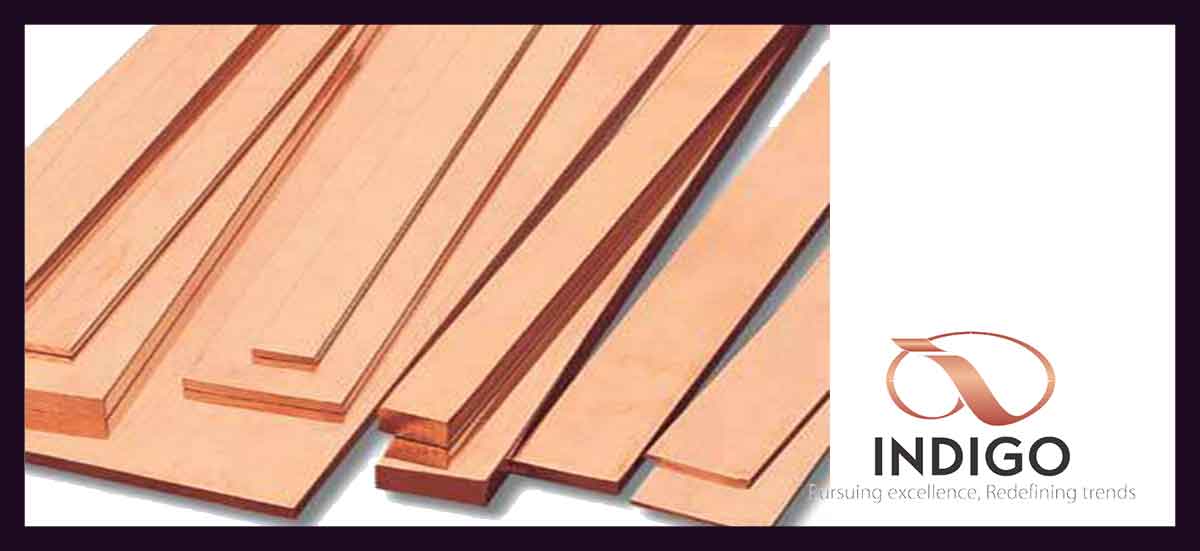
Copper Flats – Specifications, Standards, Sizes and Industrial Applications
Copper flats are solid rectangular copper sections widely used in electrical, power distribution, industrial fabrication, marine, refinery and heavy engineering applications. Known for their excellent electrical conductivity, mechanical strength and corrosion resistance, they serve as critical current-carrying and structural components in demanding operating environments.
Manufactured from high-purity copper grades and supplied in precise dimensions, they are commonly used as busbars, earthing conductors, switchgear components, transformer connections and industrial fabrications where reliability and long service life are essential.
Material Properties
Copper flats are produced using electrolytic tough pitch (ETP) copper or phosphorus-deoxidized copper, offering conductivity levels of up to 99.9% pure copper. These properties ensure minimal electrical losses, excellent thermal conductivity and stable mechanical performance.
The high ductility of copper allows flats to be easily bent, punched, drilled and fabricated without cracking, making them suitable for complex electrical assemblies and customized industrial components.
Grades and Chemical Composition
Common copper grades used include:
- C11000 – Electrolytic Tough Pitch (ETP) Copper
- C10200 – Oxygen-Free High Conductivity (OFHC) Copper
- C12200 – Phosphorus Deoxidized Copper
Grade selection depends on electrical conductivity requirements, welding or brazing needs and the operating environment of the application.
Manufacturing Process
They are manufactured through hot rolling or continuous casting followed by cold rolling to achieve precise thickness, width and surface finish. Controlled annealing processes are applied to achieve the desired mechanical properties such as hardness, tensile strength and elongation.
Surface finishing processes ensure smooth edges, uniform thickness and clean surfaces suitable for electrical contact and further fabrication.
Standards and Specifications
- ASTM B187 – Copper bar, bus bar and shapes
- ASTM B152 – Copper sheet, strip and plate
- EN 13601 – Copper busbars and profiles
- EN 1652 – Copper plate, sheet and strip
- JIS H3100 – Copper and copper alloy plates
- IS 1897 – Copper bars, flats and sections
Sizes and Dimensional Range
They are available in a wide range of widths and thicknesses to suit various electrical and industrial requirements. Standard thicknesses typically range from 3 mm to 50 mm, while widths can range from 10 mm to over 200 mm.
Custom sizes, tight tolerances and cut-to-length supply are commonly provided for switchgear manufacturers, transformer OEMs and industrial fabricators.
Surface Finish and Condition
They can be supplied in mill finish, bright finish or tinned surface condition depending on application requirements. Tinned copper flats provide enhanced corrosion resistance and improved solderability, especially in marine and high-humidity environments.
Applications
Electrical & Power Distribution
- Busbars and power distribution panels
- Switchgear and control panels
- Transformer and generator connections
- Earthing and grounding systems
Industrial & Engineering
- Fabricated electrical components
- Heat transfer components
- Industrial machinery parts
Marine & Offshore
- Shipboard electrical systems
- Offshore power distribution
- Corrosion-resistant electrical conductors
Renewable Energy & Infrastructure
- Solar power busbar systems
- Wind energy electrical connections
- Electric vehicle charging infrastructure
Quality Control and Testing
They undergo stringent quality control procedures including chemical composition testing, electrical conductivity testing, dimensional inspection and surface finish evaluation. Mechanical properties such as tensile strength and elongation are verified to meet applicable standards.
Strict quality assurance ensures consistent performance, long service life and safe operation in critical electrical and industrial systems.
Advantages of Copper Flats
- Excellent electrical and thermal conductivity
- High corrosion resistance
- Superior formability and machinability
- Long service life with minimal maintenance
- Compliance with global standards
Conclusion
Copper flats remain a fundamental material in electrical and industrial infrastructure due to their unmatched conductivity, reliability and fabrication versatility. From power distribution and switchgear to marine and renewable energy systems, copper flats continue to play a vital role in modern engineering and industrial applications.
Manufactured to stringent international standards and supplied in precise dimensions, high-quality copper flats ensure efficient energy transmission, safety and durability across a wide range of demanding environments.