
Copper-Nickel Fittings for Marine & Offshore Applications
A seawater piping system is only as reliable as its weakest joint, and in marine and offshore environments, that joint faces a punishing combination of chloride exposure, biofouling, vibration, and constant flow. Copper-nickel fittings exist precisely for this environment, engineered to connect, redirect, and terminate copper-nickel pipe runs without becoming the point where the system eventually fails.
Like the pipe they connect, copper-nickel fittings come in different alloy grades, shapes, and jointing configurations, each suited to a particular part of a vessel's or platform's piping network. This guide covers what copper nickel fittings are, how the 90/10 and 70/30 grades compare, the full range of shapes available, and what to look for when sourcing fittings for marine or offshore service.
What are copper-nickel fittings?
Copper nickel fittings, also known as cupronickel fittings, are connective piping components manufactured from the same copper-nickel alloy family used in copper nickel pipe, typically containing 90% or 70% copper with the balance made up of nickel, along with controlled additions of iron and manganese for stability.
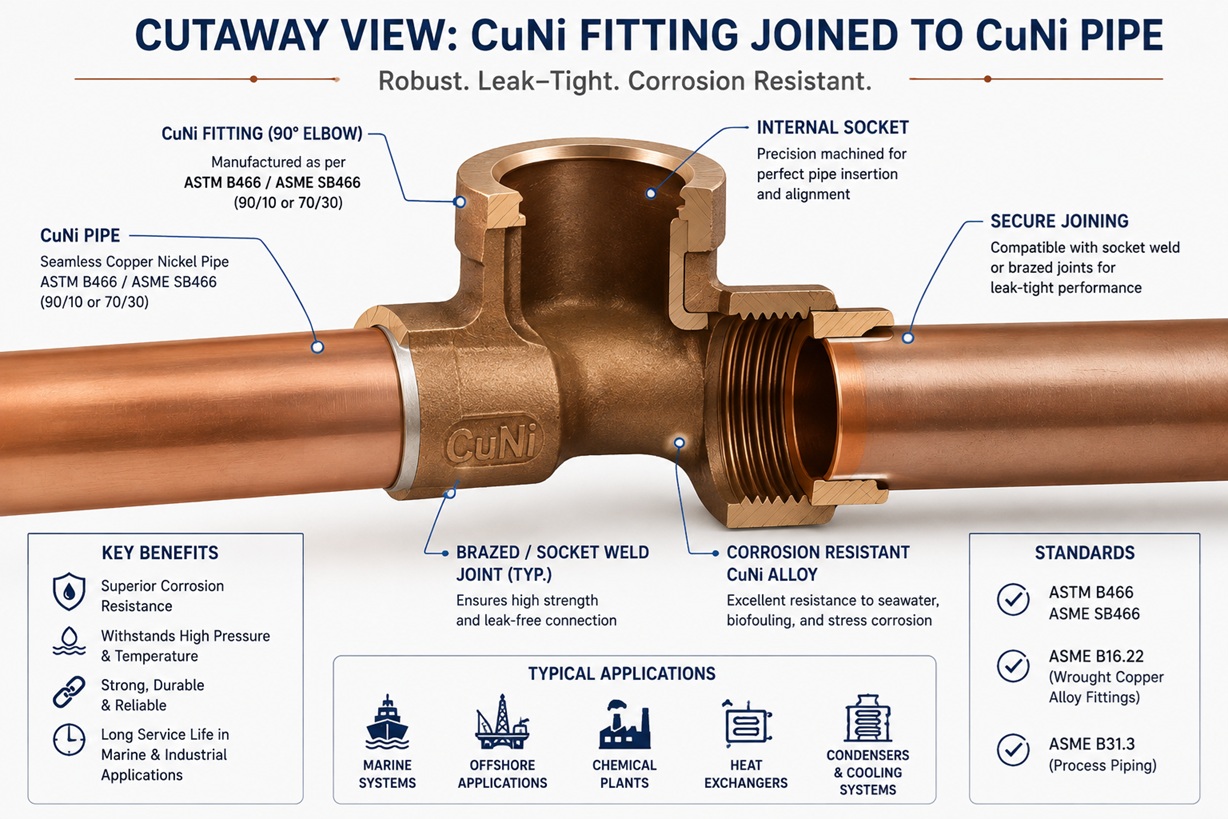
Where copper-nickel pipe carries the flow, cupronickel fittings make the network possible: elbows change direction, tees create branches, reducers step between diameters, couplings extend straight runs, and flanges provide bolted connection points to valves, pumps, and equipment. Each fitting is manufactured to accept the same outside diameter as the pipe it will be joined to, with dimensional tolerances tight enough to support a strong, leak-tight joint once brazed, welded, or bolted into place.
Because copper-nickel fittings sit at every stress point in a seawater system—corners, branches, and equipment connections—their alloy composition and manufacturing quality matter just as much as the pipe itself. A fitting produced to a lower grade or with inconsistent wall thickness can become the weak link in an otherwise well-specified system.
CuNi 90/10 Fittings vs. CuNi 70/30 Fittings
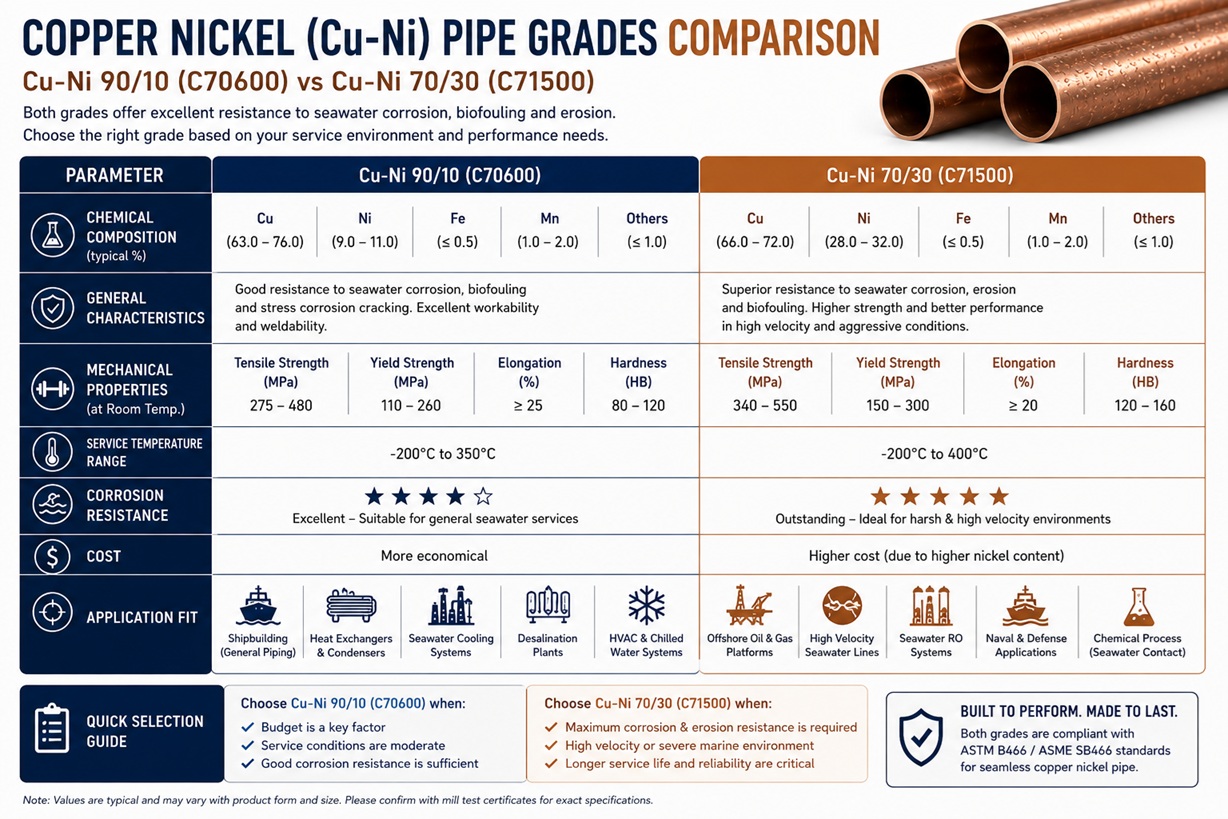
As with copper-nickel pipe, fittings are manufactured in both 90/10 and 70/30 grades, and the choice between them follows the same logic used to select the pipe itself matched to the demands of the specific system.
CuNi 90/10 fittings, containing roughly 90% copper and 10% nickel, offer solid general-purpose corrosion resistance at a more accessible cost, making them the more commonly specified grade for standard seawater piping systems, general shipboard cooling lines, moderate-duty ballast systems, and offshore piping that doesn't face extreme flow velocities or exceptionally aggressive water conditions.
CuNi 70/30 fittings, containing roughly 70% copper and 30% nickel, provide meaningfully higher mechanical strength and better resistance to erosion-corrosion under high-velocity flow, which makes them the preferred choice for critical seawater intakes, high-flow piping sections, and offshore platform systems where the consequences of a fitting failure are severe.
A useful specification principle: the fitting grade should always match the pipe grade it connects to, both to maintain consistent corrosion behavior across the joint and to avoid galvanic mismatches at the connection point. Mixing 90/10 fittings with 70/30 pipe (or the reverse) is a common but avoidable sourcing error, and confirming grade consistency across an entire piping run should be a standard check before installation begins.
Types of Copper Nickel Fittings
A complete range of copper-nickel fittings covers the same core shapes found in copper and copper alloy piping generally, each manufactured to the alloy grade and standard required for marine service.
Copper-nickel elbowChanges the direction of a pipe run, typically at 90 degrees or 45 degrees, available in both short-radius and long-radius configurations depending on space constraints and flow requirements.
A copper-nickel tee splits a single flow path into two or merges two into one, specified by the size of all three ports. Reducing tees, where the branch diameter differs from the main run, are common wherever a secondary seawater line taps off a larger main.
A copper-nickel reducer transitions a run between two different pipe diameters, either as a concentric reducer, keeping both ends on the same centerline, or as an eccentric reducer that keeps one side flat to avoid trapped air or sediment in horizontal runs.
Copper-nickel coupling Joins two lengths of pipe of the same diameter in a straight run, used to extend a line or splice in a repaired section during maintenance.
A copper-nickel flangeprovides a bolted connection point between a pipe run and a valve, pump, tank, or other piece of equipment, allowing sections of a seawater system to be disconnected for maintenance without cutting the pipe itself. Flanges are especially critical in marine systems, where equipment such as pumps and strainers requires periodic removal for servicing.
Together, this range covers the great majority of routing, branching, and equipment-connection needs found in shipboard and offshore seawater systems.

Marine Copper Nickel Fittings: Why Shipbuilders Specify Them
Marine copper-nickel fittings have earned a default position in shipbuilding specifications for reasons that go beyond simple corrosion resistance.
Seawater cooling systems, ballast and bilge piping, and firefighting mains aboard vessels all subject fittings to continuous seawater exposure, constant vibration from engines and sea motion, and, in some sections, high flow velocities. Fittings manufactured from carbon steel or standard copper alloys degrade far faster under these combined stresses than copper-nickel, which resists both the corrosion and the biofouling that would otherwise progressively restrict flow through a fitting's interior.
Classification societies overseeing vessel construction and inspection frequently reference copper-nickel fittings by name in their piping requirements for seawater systems, which means specifying anything else for these applications can create compliance issues during survey and certification. This regulatory familiarity, combined with decades of proven service history, is a major reason shipbuilders default to CuNi fittings for seawater service rather than treating the choice as optional.

Offshore Applications of Copper-Nickel Fittings
Offshore platforms present many of the same seawater challenges as shipboard systems, with the added complication of remote location and higher consequences for unplanned maintenance.
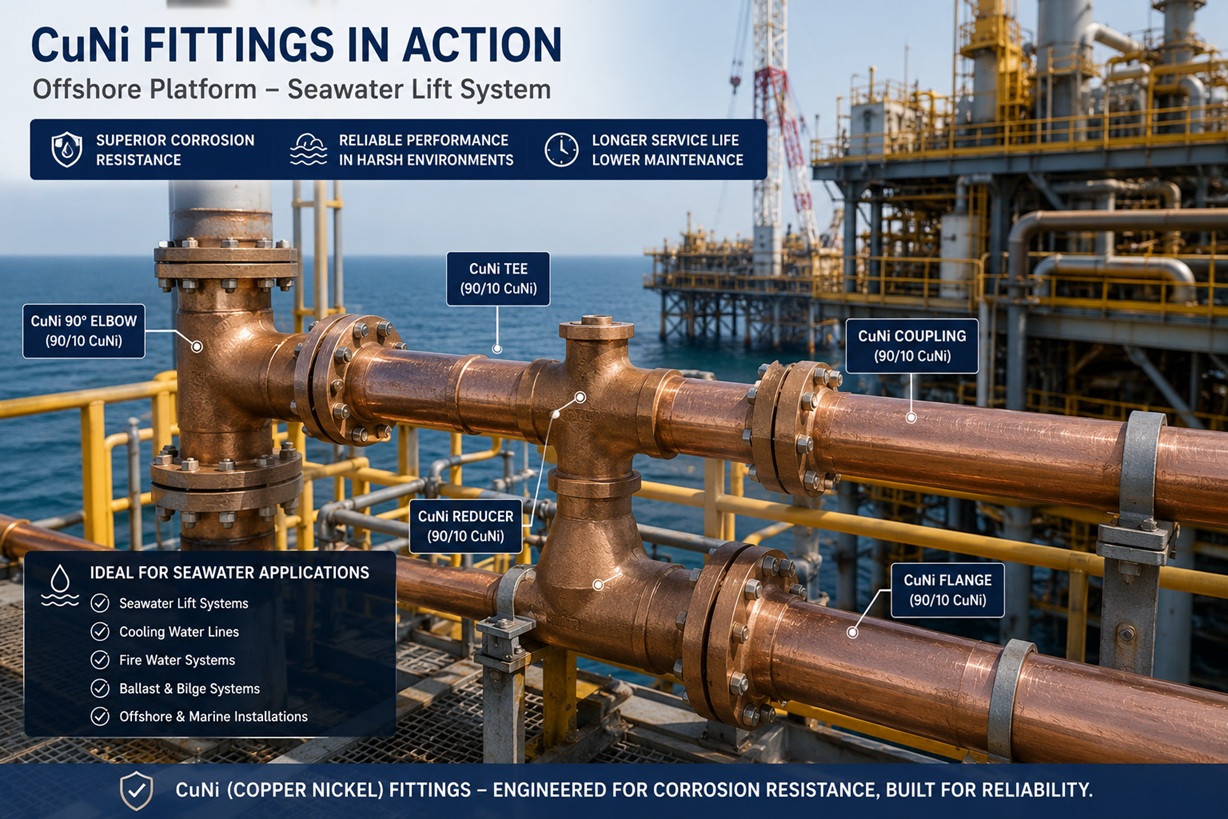
Copper-nickel fittings are used extensively in offshore seawater lift systems, which draw water from the sea for cooling and processing needs, as well as in firewater mains, where reliability is a direct safety requirement rather than a maintenance convenience. Because offshore platforms are difficult and expensive to access for unplanned repairs, the corrosion resistance and long service life copper-nickel fittings offer translate directly into reduced downtime and lower lifecycle costs compared to alternative materials that might require more frequent intervention.
Floating production platforms and subsea-adjacent topside systems also rely on copper-nickel fittings wherever seawater handling is involved, reinforcing the material's position as a default choice rather than a specialty option in offshore engineering.
Jointing Methods for Copper-Nickel Fittings
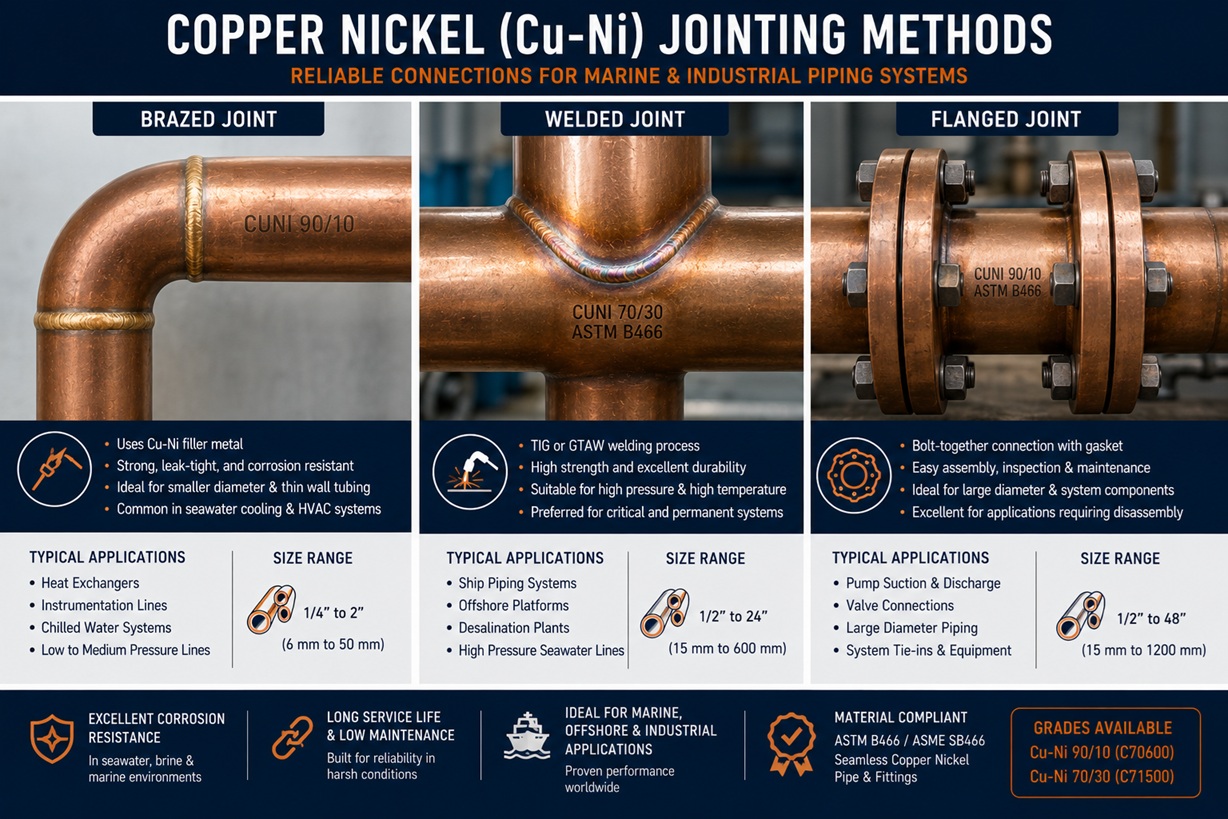
Copper-nickel fittings are joined to pipe using a small number of established methods, each suited to different parts of a piping system.
Brazing is common for smaller-diameter copper-nickel fittings, using a filler metal with a melting point compatible with the CuNi alloy to produce a strong, leak-tight joint without the higher heat input associated with welding, which is useful where minimizing heat-affected zone size in the base metal matters.
Welding is typically used for larger-diameter fittings and structural piping runs, producing a joint with mechanical strength suited to higher-pressure or higher-stress sections of a system, though it requires welders qualified specifically for copper-nickel alloys, since the welding parameters differ meaningfully from those used on carbon steel or stainless steel.
Flanged connections, using copper-nickel flanges bolted together with a gasket between them, provide a joint that can be disassembled without cutting or re-welding pipe, essential anywhere equipment needs periodic removal for maintenance, such as at pump and valve connections throughout a seawater system.
Selecting the right method for each section of a system—brazed for smaller branch lines, welded for main runs, and flanged at equipment connections—is a standard part of specifying a complete copper-nickel piping network rather than a one-size-fits-all decision.
Standards, Certification & Traceability
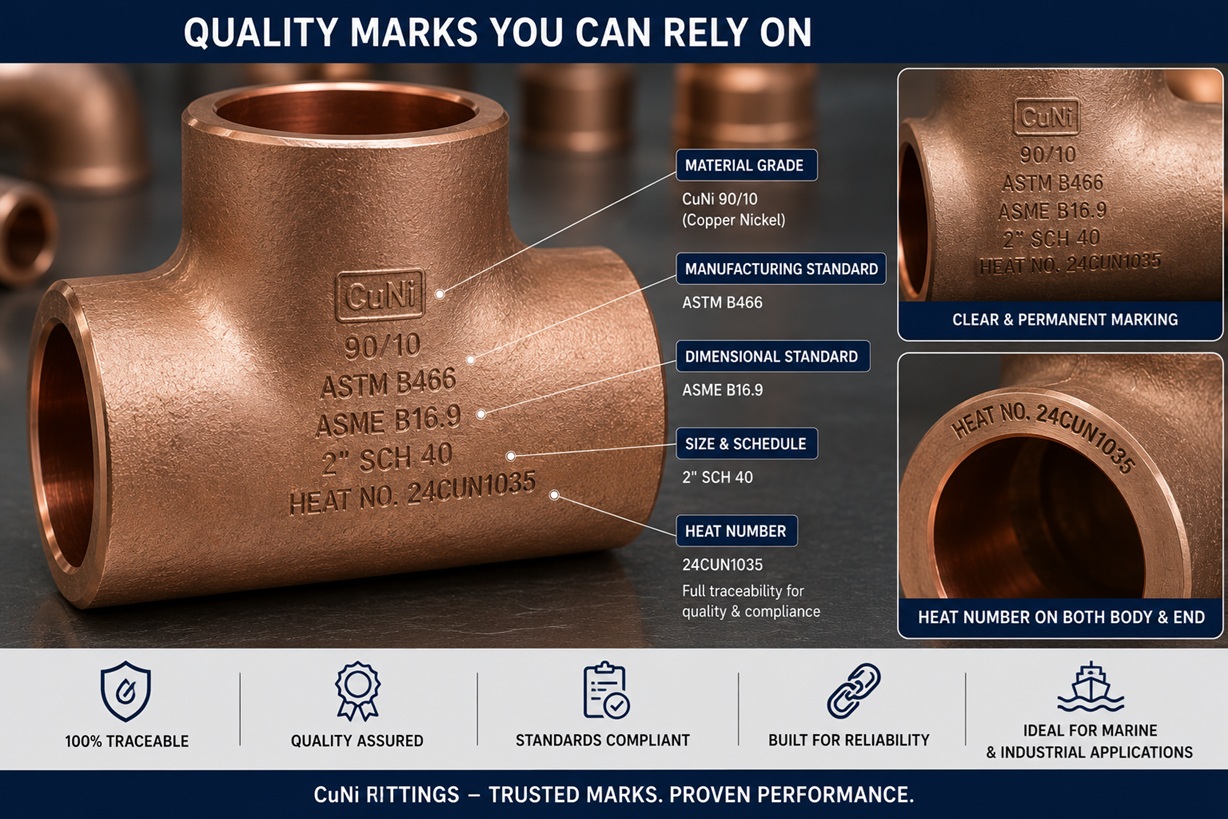
Copper-nickel fittings intended for marine and offshore service are typically manufactured and certified against recognized standards covering alloy composition, dimensional tolerances, and mechanical properties, with classification society approval often required on top of the base material standard.
Mill test certification for CUNI fittings should confirm chemical composition of the specific heat used, mechanical test results including tensile strength and elongation, and dimensional compliance with the relevant fitting standard. For marine and offshore projects, full traceability linking each fitting back to its production heat and test records is typically a contractual and classification society requirement, not an optional extra, since it allows any future material concern to be traced back to a specific batch rather than the entire installed system.
Requesting and retaining this documentation at the time of purchase, rather than after installation, avoids the far more difficult process of trying to establish traceability retroactively during a future survey or incident investigation.
Choosing a Copper-Nickel Fittings Supplier or Manufacturer
Sourcing copper-nickel fittings for marine or offshore work requires more scrutiny than sourcing standard copper fittings, given the certification and traceability demands typical of these projects.
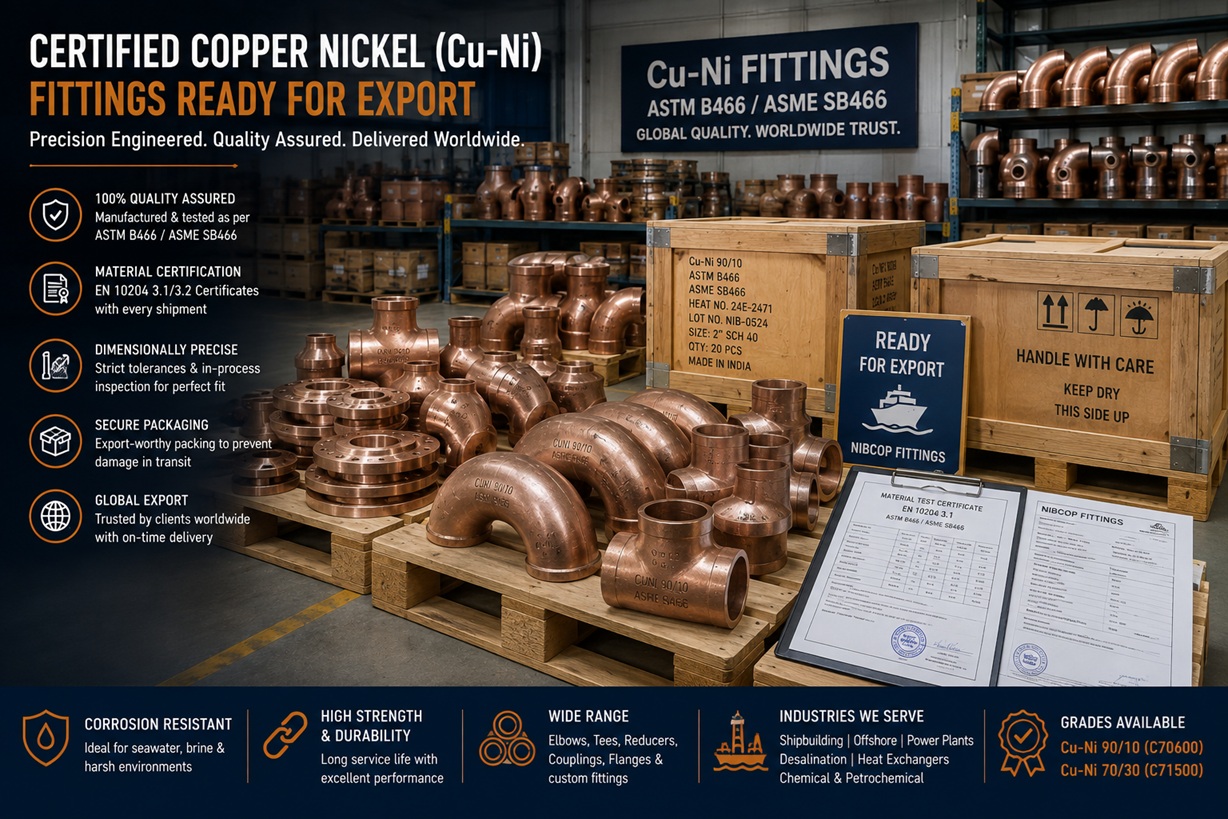
A dependable copper-nickel fittings supplier should maintain stock across both 90/10 and 70/30 grades in the full range of shapes, elbows, tees, reducers, couplings, and flanges needed to complete a project without gaps that force last-minute substitutions. Equally important is the supplier's familiarity with classification society requirements, since a supplier experienced in marine and offshore projects will already understand the documentation a survey inspector expects to see.
A copper-nickel pipe fittings manufacturer with in-house testing capability offers an added layer of confidence, since batch-level mechanical and chemical testing can be verified directly rather than taken on faith from a third party. For international projects, working with a manufacturer or supplier experienced in export documentation and classification society liaison across multiple markets tends to reduce delays considerably compared to a domestic-only supplier navigating international requirements for the first time.
Frequently Asked Questions
What is the difference between CuNi 90/10 fittings and CuNi 70/30 fittings? 90/10 fittings contain roughly 90% copper and 10% nickel and suit general seawater service at a lower cost, while 70/30 fittings contain roughly 30% nickel, offering higher strength and better resistance in high-velocity or more aggressive seawater conditions.
Should the fitting grade always match the connected pipe grade? Yes, mixing 90/10 fittings with 70/30 pipe (or vice versa) can create inconsistent corrosion behavior and galvanic mismatches at the joint, so grade consistency across a full piping run is a standard specification check.
What's the difference between a copper-nickel coupling and a copper-nickel flange? A coupling creates a permanent joint between two same-size pipe ends in a straight run, while a flange provides a bolted, disassemblable connection point typically used wherever equipment like a pump or valve needs periodic removal.
Are copper-nickel fittings brazed, welded, or flanged? All three methods are used depending on the application: brazing suits smaller-diameter fittings, welding suits larger structural runs, and flanged connections are used wherever a joint needs to be disassembled without cutting pipe.
Why do classification societies reference copper-nickel fittings specifically? Copper nickel's long service history in seawater systems, combined with its corrosion and biofouling resistance, has led many classification societies to reference it directly in piping requirements for marine seawater systems.
What documentation should I request when ordering copper-nickel fittings? Mill test certification confirming chemical composition, mechanical properties, and dimensional compliance, along with full traceability linking each fitting to its production heat, is essential for marine and offshore projects subject to survey.
How do I choose between different copper-nickel fitting suppliers? Prioritize suppliers or manufacturers with full-range stock across both alloy grades, experience with classification society documentation, in-house testing capability where possible, and a track record on marine or offshore projects similar to yours.
Conclusion
Copper-nickel fittings complete the same corrosion-resistant, biofouling-resistant system that copper-nickel pipe begins, and in marine and offshore environments, getting the fitting selection, right grade, shape, jointing method, and certification matters just as much as getting the pipe right. Understanding the differences between 90/10 and 70/30 fittings, the full range of shapes available, and what proper documentation looks like puts you in a far stronger position to specify a seawater piping system built to perform through decades of service at sea.