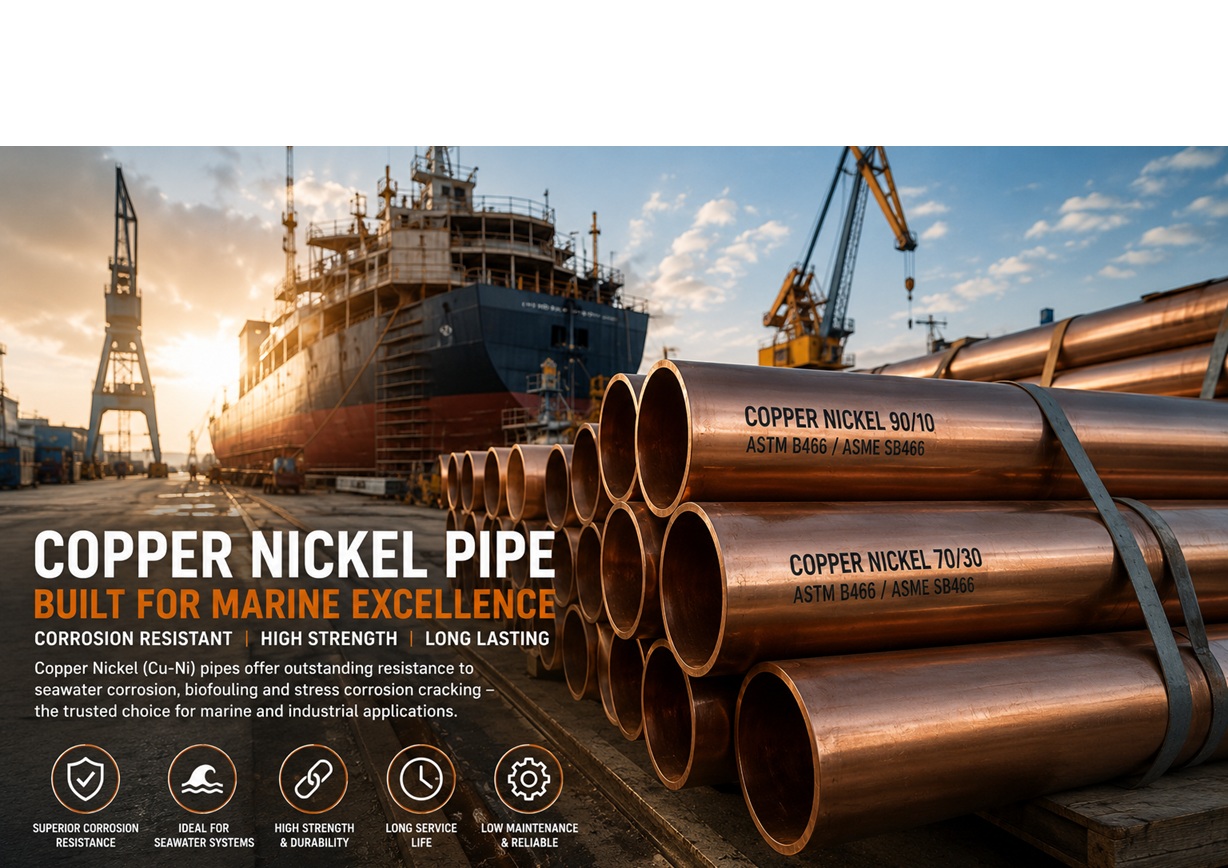
Copper Nickel Pipe: 90/10 & 70/30 Guide
Few environments punish piping materials the way seawater does. Constant chloride exposure, biofouling, erosion from moving water, and galvanic interaction with dissimilar metals all combine to shorten the service life of ordinary pipe grades far faster than most engineers expect. That's the environment copper-nickel pipe was developed for, and after decades of service in shipbuilding, offshore platforms, and desalination plants, it remains the material of choice wherever seawater and reliability have to coexist.
CuNi pipe isn't a single product, though. The two dominant grades 90/10 and 70/30 differ in composition, mechanical strength, and cost, and choosing between them (or between seamless and other manufacturing methods) has real consequences for a project's performance and budget. This guide breaks down what copper nickel pipe is, how the two main grades compare, what ASTM B466 actually specifies, and where each variant fits best.
What is copper-nickel pipe?
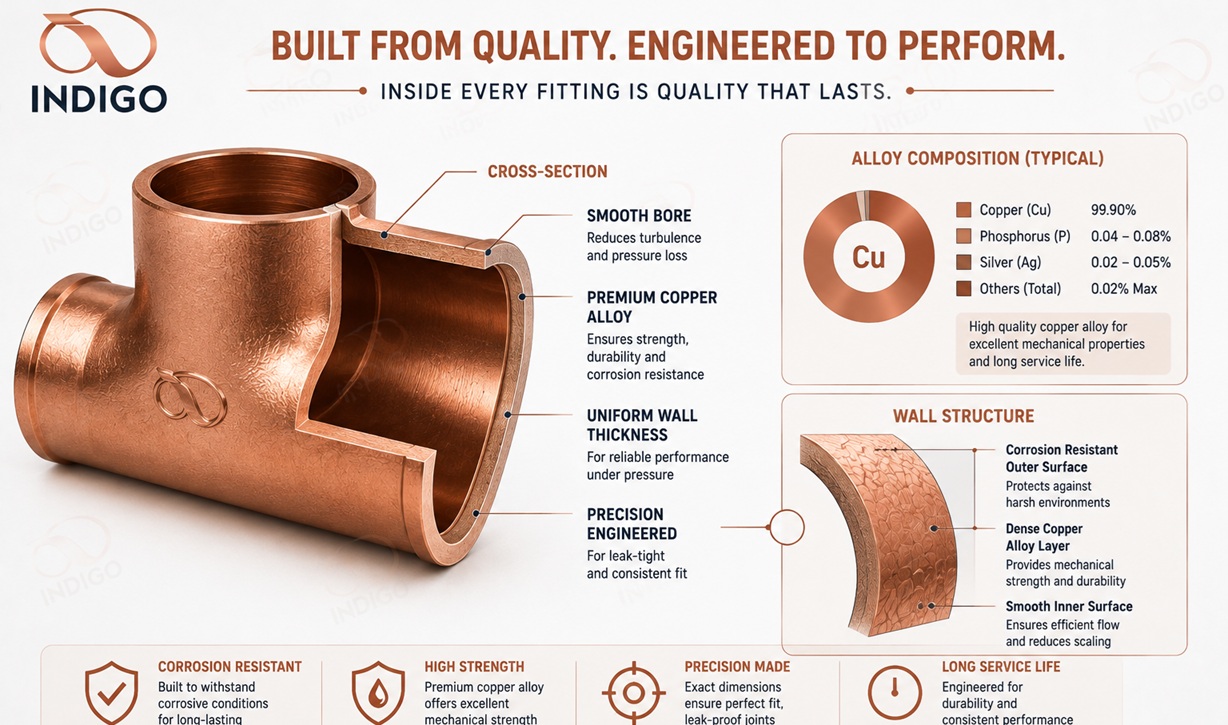
Copper-nickel pipe, sometimes called cupronickel pipe, is a piping product made from a copper-based alloy containing a defined percentage of nickel, along with small additions of iron and manganese that further enhance corrosion resistance and mechanical stability. The nickel content is what fundamentally distinguishes this material from plain copper pipe; it dramatically improves resistance to erosion-corrosion, chloride attack, and biofouling in ways that copper alone cannot match.
The alloy is produced by melting copper and nickel together in carefully controlled proportions, then casting the mixture into billets that are subsequently extruded and drawn into pipe form. Because the mechanical and corrosion-resistant properties of the finished pipe depend heavily on getting this composition precisely right, copper nickel pipe production is far more tightly controlled than standard copper tube manufacturing, with alloy composition verified at multiple stages before a batch is certified for shipment.
Copper-nickel pipe is available in various tempers and wall thicknesses depending on the pressure and mechanical demands of the system it will serve, but its defining characteristic across all variants is the same: a piping material engineered specifically to survive where seawater would quickly destroy conventional alternatives.
Copper Nickel 90/10 Pipe vs. Copper Nickel 70/30 Pipe
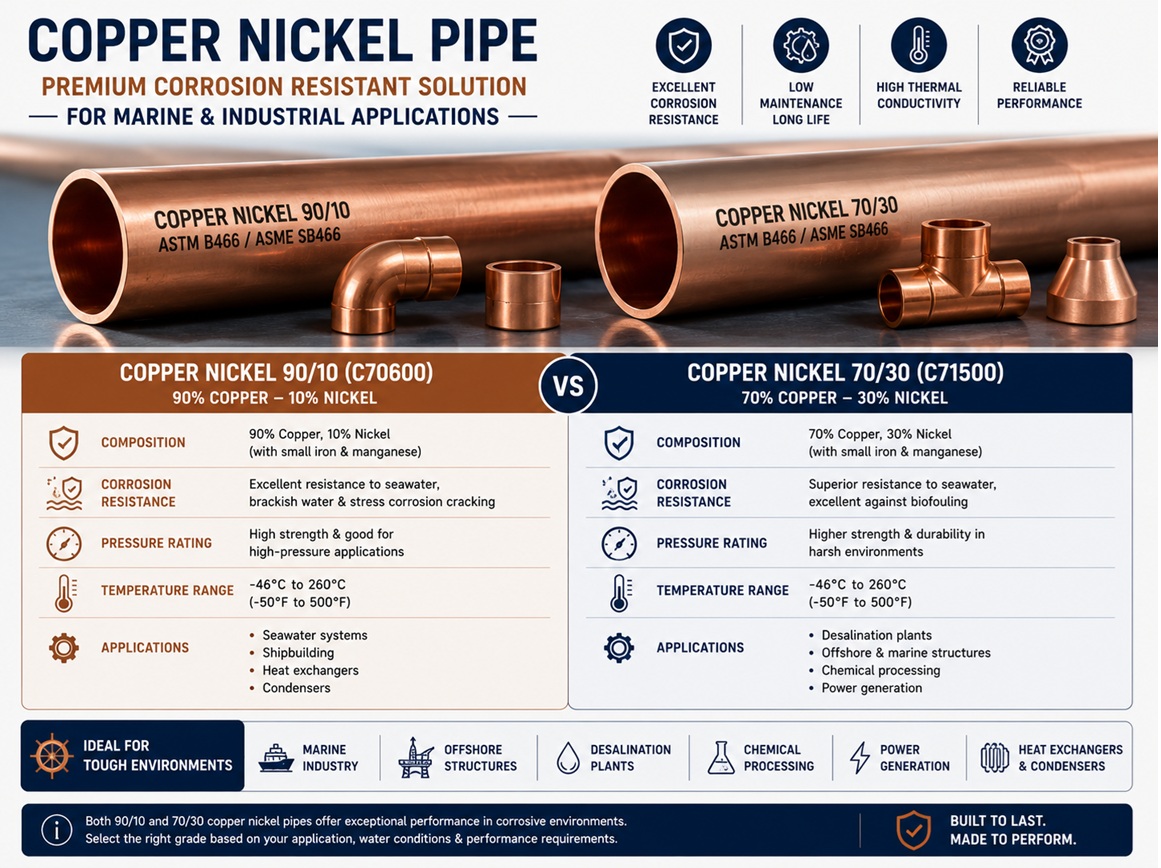
The two most widely used copper-nickel alloys are known by their approximate copper-to-nickel ratio, and the difference between them is more than academic; it directly affects cost, strength, and where each is best applied.
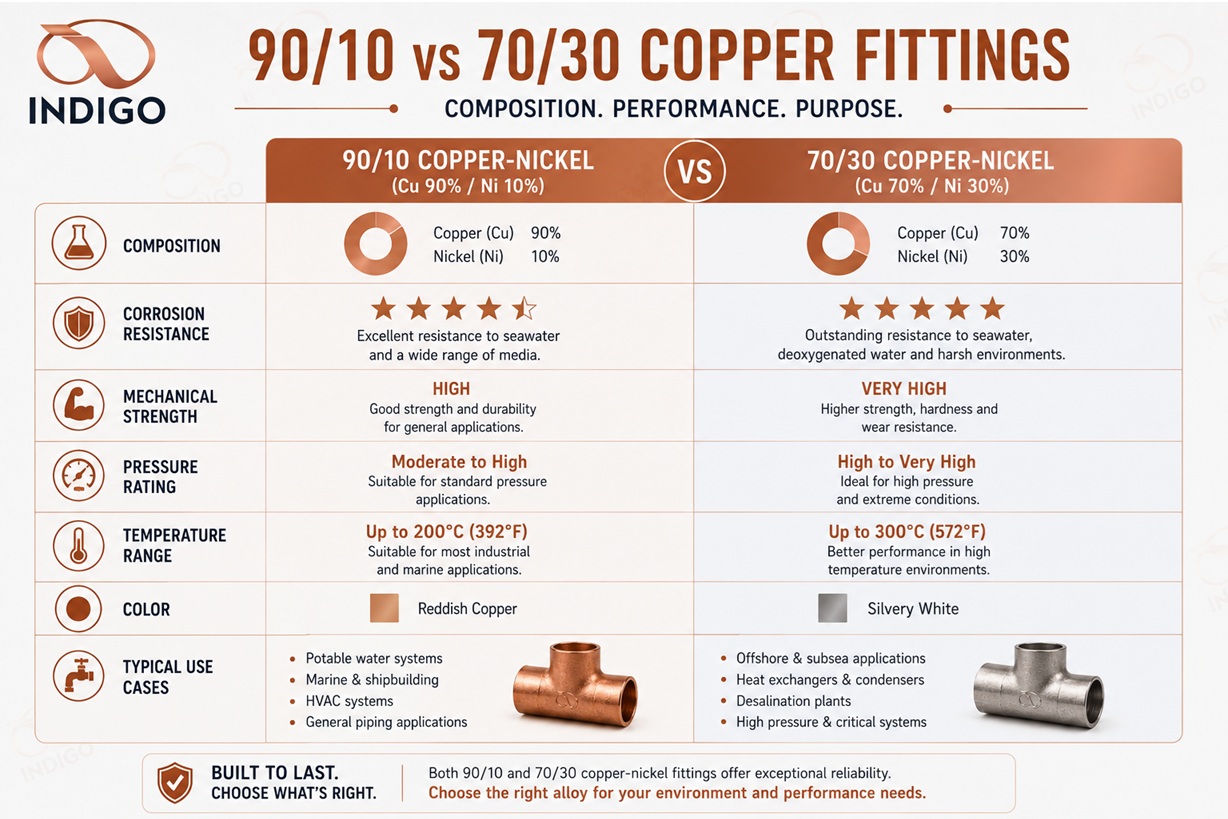
Copper-nickel 90/10 pipe contains roughly 90% copper and 10% nickel, along with small additions of iron and manganese for stability. It offers strong general-purpose corrosion resistance at a lower cost than the 70/30 grade, which makes it the more commonly specified option for seawater piping systems where extreme conditions aren't present, general shipboard piping, condenser tubing, and moderate-duty offshore applications.
Copper-nickel 70/30 pipe contains roughly 70% copper and 30% nickel, giving it noticeably higher mechanical strength, better resistance to high-velocity erosion-corrosion, and superior performance in more aggressive seawater conditions. This comes at a higher material cost, which is why 70/30 is typically reserved for applications with higher flow velocities, more severe operating conditions, or greater consequence of failure, such as critical seawater intakes, high-flow-rate piping, and offshore platform systems where downtime or failure carries significant risk.
As a rule of thumb, 90/10 covers the majority of standard marine and industrial seawater applications cost-effectively, while 70/30 is reserved for situations where flow velocity, water aggressiveness, or criticality push beyond what the 90/10 grade can reliably handle. Confirming expected flow velocity and water chemistry with a materials engineer before finalizing a grade choice is well worth the extra step, since over-specifying 70/30 unnecessarily adds cost, while under-specifying 90/10 in a high-velocity system risks premature erosion.
ASTM B466 Copper Nickel Pipe: Standards & Specifications
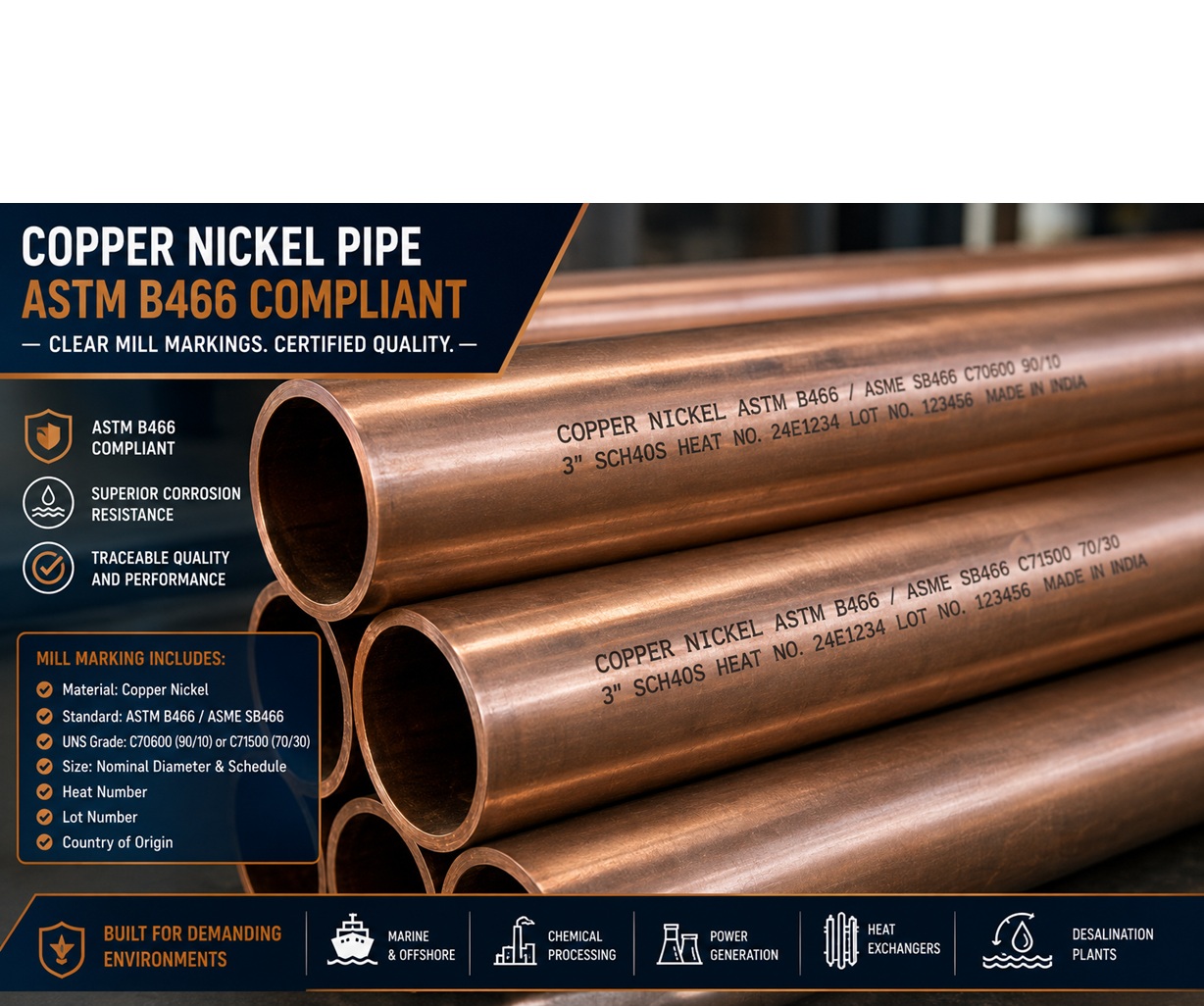
ASTM B466 is the primary specification governing seamless copper-nickel pipe and tube used in marine, offshore, and industrial seawater applications, and it's the standard most commonly referenced when specifying CuNi pipe for critical service.
The standard defines the permitted alloy compositions covering both 90/10 and 70/30 grades, along with the controlled additions of iron and manganese as well as dimensional tolerances for outside diameter and wall thickness, mechanical property requirements including tensile strength and elongation, and the testing methods used to verify a batch meets specifications before certification.
ASTM B466 copper-nickel pipe is typically supplied in an annealed condition, which provides the ductility needed for bending and forming during installation while maintaining the alloy's full corrosion-resistant properties. Mill test certificates verifying compliance with ASTM B466 covering chemical composition, mechanical properties, and dimensional accuracy are standard documentation that project engineers and inspectors expect to see before pipe is accepted into a marine or offshore project and are worth requesting and retaining for the life of the installation.
Copper-Nickel Seamless Pipe: Manufacturing & Advantages
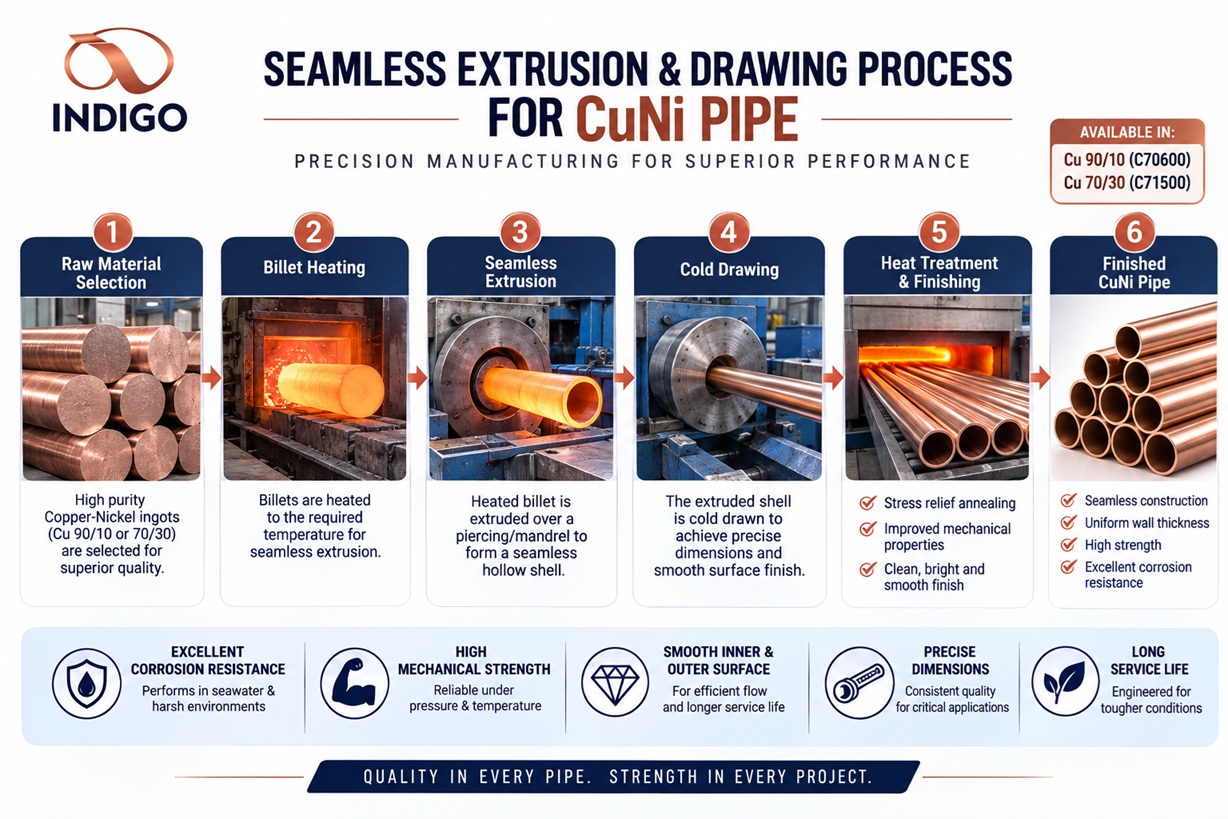
Copper-nickel seamless pipe is manufactured as a single continuous piece with no welded or brazed longitudinal joint, which matters considerably in seawater service where a welded seam represents a potential weak point for both mechanical failure and localized corrosion.
Production begins with a cast copper-nickel billet that's pierced and extruded into a hollow shell, then drawn through a series of dies to achieve the final outside diameter and wall thickness, with intermediate annealing steps used to restore ductility as the pipe is progressively reduced in size. The result is a pipe with consistent wall thickness around its full circumference and no seam to serve as a point of weakness under pressure or vibration.
This seamless construction is a major reason copper-nickel pipe holds up so well in demanding marine environments. Seawater cooling systems, ballast piping, and offshore process lines all subject piping to a combination of pressure, vibration, and corrosive exposure that a welded seam would be more likely to fail under over time. For critical seawater service, specifying seamless construction over welded alternatives is generally considered a baseline requirement rather than an optional upgrade.
Marine Copper-Nickel Pipe & Seawater Applications
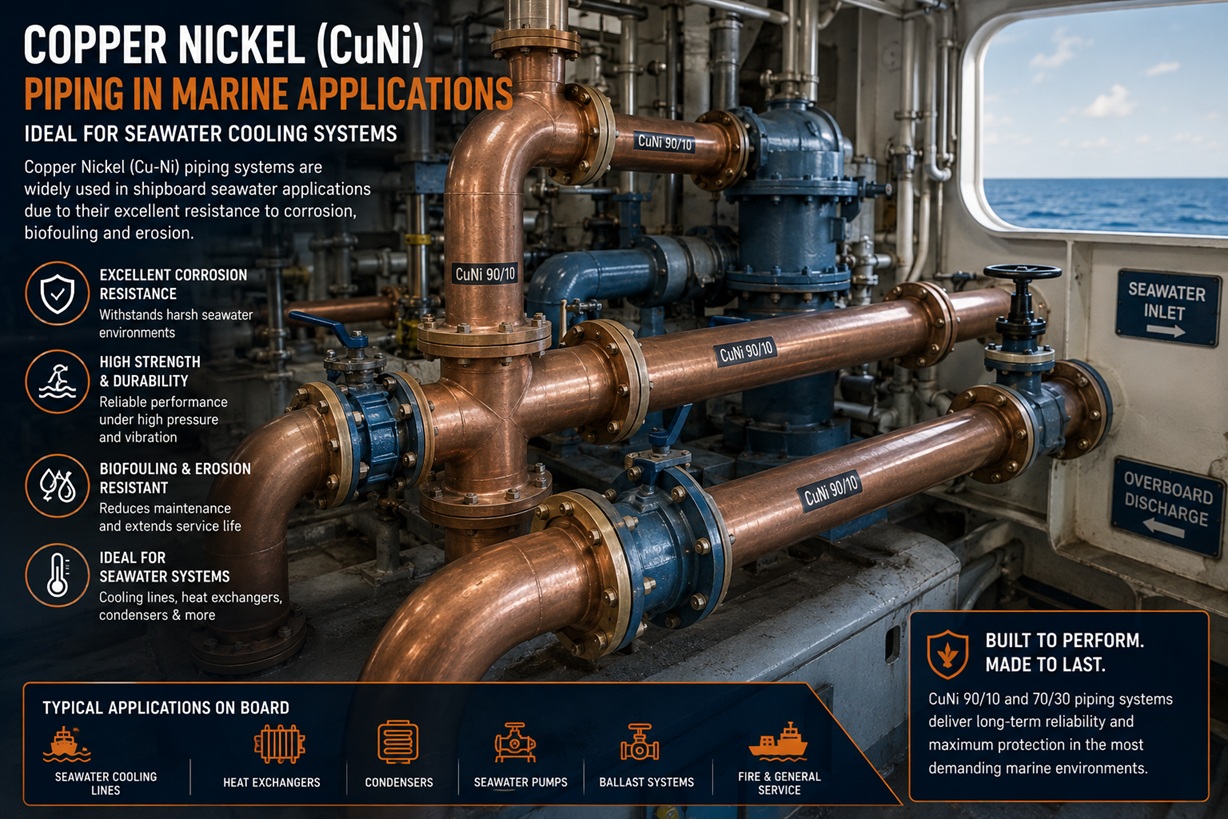
Marine copper-nickel pipe is arguably the material's defining application, the environment it was specifically developed to withstand, and the one where its advantages over alternative materials are most pronounced.
Aboard ships and offshore platforms, copper-nickel pipe for seawater service is used extensively in seawater cooling systems, ballast and bilge piping, firefighting systems, and condenser tubing, where constant exposure to seawater would rapidly degrade carbon steel or even standard copper piping. The alloy's combination of corrosion resistance, biofouling resistance, and erosion resistance under flowing seawater conditions makes it uniquely suited to these continuous-duty systems.
Offshore platforms rely on copper-nickel pipe for similar reasons, particularly in seawater lift systems and firewater piping, where reliability isn't just a maintenance consideration but a safety requirement. Desalination plants also depend heavily on CuNi piping throughout intake and process systems, where sustained exposure to concentrated seawater brine makes standard materials impractical over the plant's operating life.
Because these applications typically involve continuous seawater exposure with no realistic option for frequent pipe replacement, the higher upfront cost of copper-nickel pipe compared to carbon steel or standard copper is consistently justified by dramatically lower long-term maintenance and replacement costs.
Corrosion Resistance & Biofouling Performance
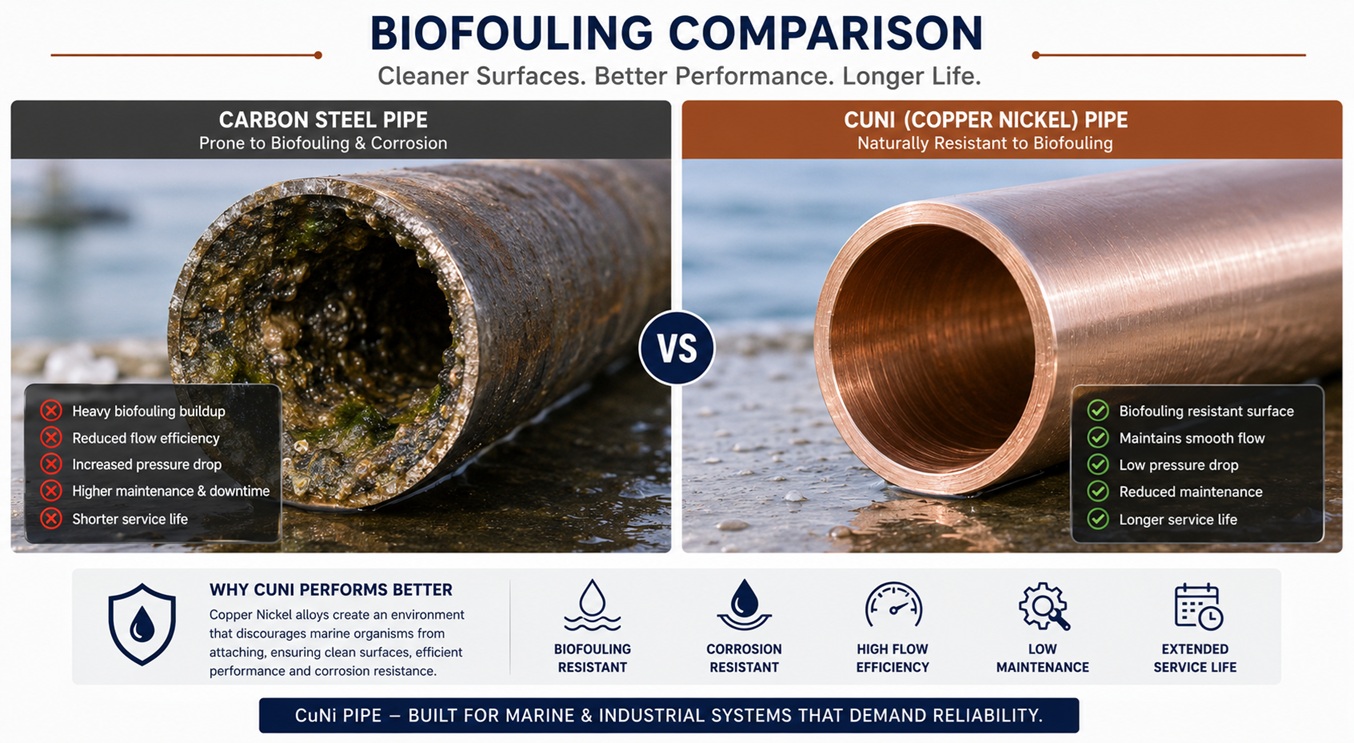
Copper-nickel pipe's reputation in marine engineering rests heavily on two related but distinct properties: general corrosion resistance and resistance to biofouling.
On the corrosion side, the alloy forms a protective, adherent oxide film when exposed to seawater, similar in principle to the patina that forms on plain copper but considerably more stable and resistant to breakdown under the chloride-rich, oxygen-variable conditions found in marine environments. This film continues to protect the underlying metal even under moderate flow velocities that would erode a less robust protective layer.
On the biofouling side, copper-nickel pipe releases trace amounts of copper ions at its surface, which inhibit the attachment and growth of marine organisms such as barnacles, mussels, and algae. This matters enormously for seawater cooling and intake systems, where biofouling on the interior surface of piping made from other materials can progressively restrict flow, reduce heat transfer efficiency, and force costly cleaning shutdowns, a maintenance burden that copper-nickel piping substantially reduces over its service life.
Copper Nickel Pipe Sizes & Specifications
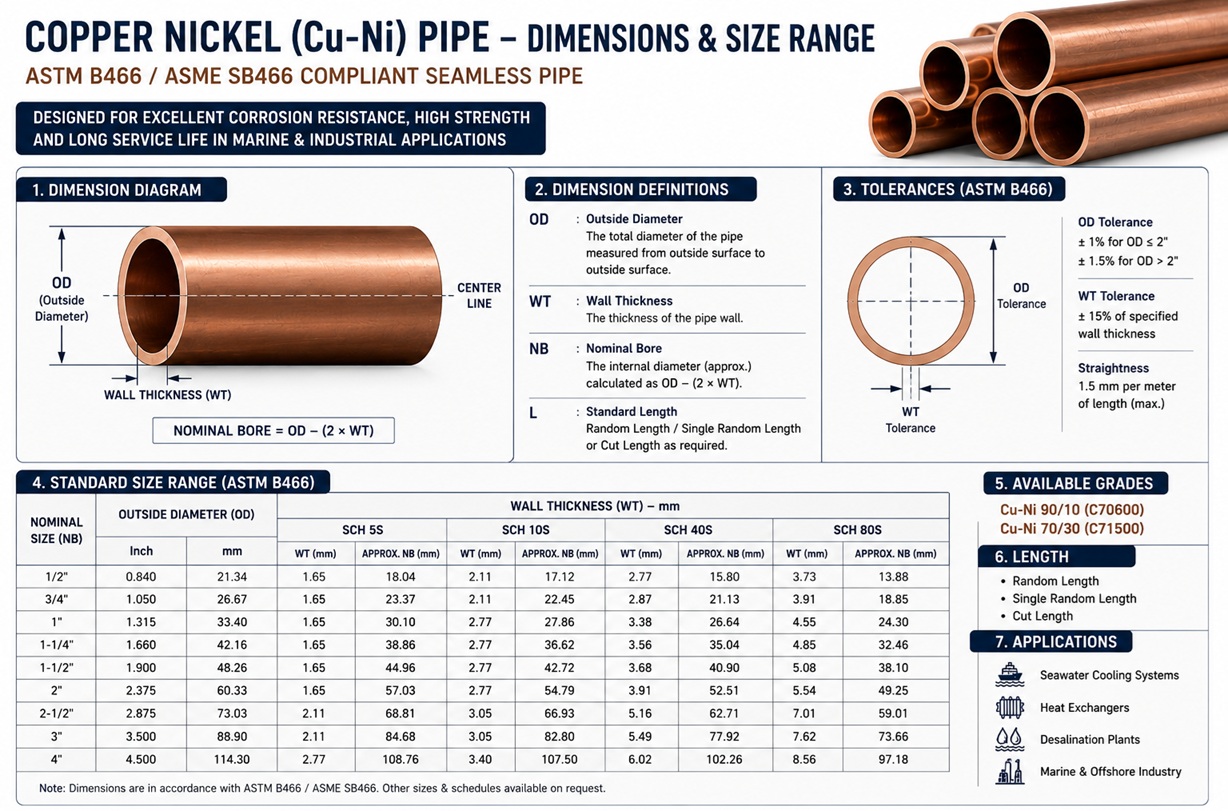
Under ASTM B466, seamless copper-nickel pipe is typically available from small nominal sizes suitable for instrumentation and control lines up to large diameters used in seawater intake and cooling water mains, with wall thickness selected according to the pressure rating, flow velocity, and mechanical demands of the specific system. As with other copper alloy piping, actual outside diameter and wall thickness should always be confirmed against the applicable standard rather than assumed from nominal size alone, since even small mismatches can create fit-up problems with mating fittings and flanges.
Project specifications should always confirm alloy grade (90/10 or 70/30), size, wall thickness, and manufacturing standard together, since these four factors collectively determine whether a given length of pipe is suitable for the intended service condition.
Applications of Copper-Nickel Pipe Across Industries
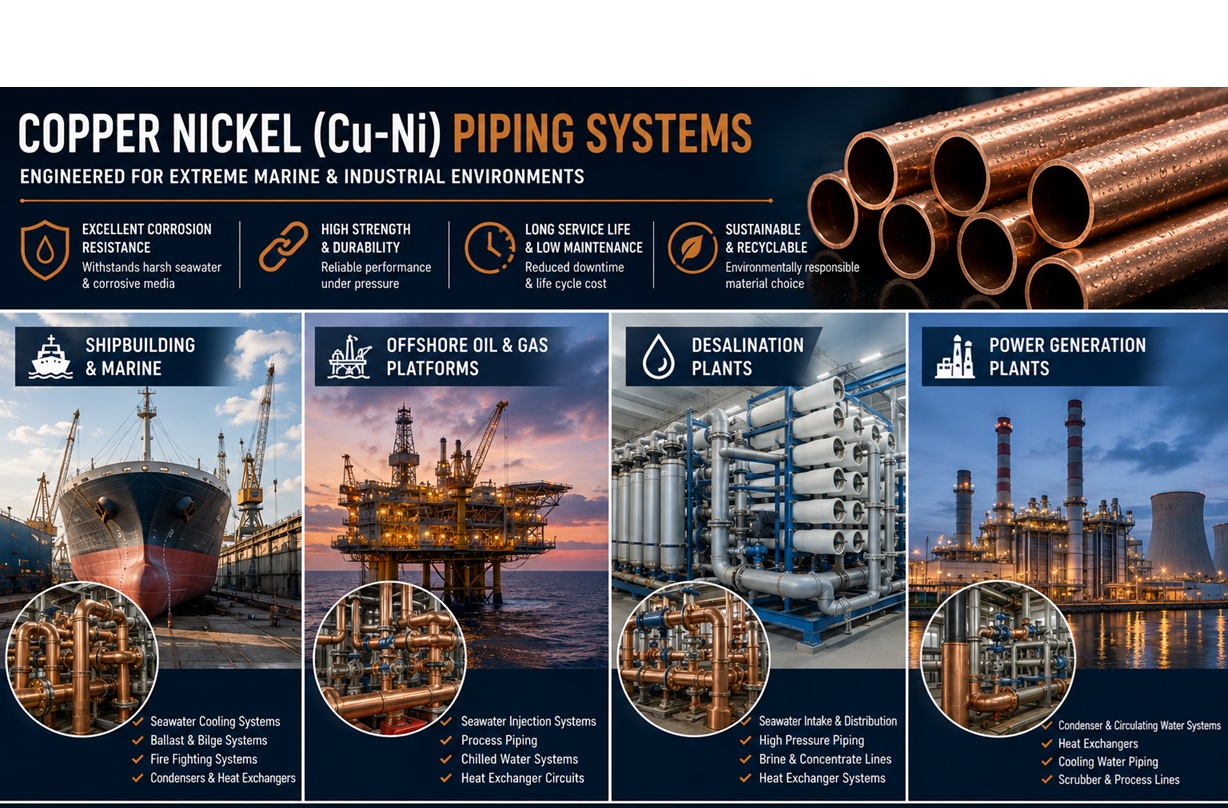
In shipbuilding, CuNi pipe is standard for seawater cooling, ballast, bilge, and firefighting systems throughout naval and commercial vessels.
In offshore oil and gas, copper-nickel pipe is used in seawater lift systems, firewater mains, and process piping exposed to marine conditions on platforms and floating production facilities.
In desalination and water treatment, copper-nickel piping handles intake and process lines carrying seawater and concentrated brine, where long-term corrosion resistance directly affects plant economics.
In power generation, particularly coastal and offshore power plants, copper-nickel pipe is used in seawater-cooled condenser and heat exchanger systems.
In general industrial process plants located in coastal or marine-adjacent environments, copper-nickel piping is frequently specified for cooling water systems exposed to brackish or saline water sources.
Across all of these sectors, the underlying justification is consistent: copper nickel pipe's higher material cost is offset by a service life and maintenance profile that alternative materials simply can't match in sustained seawater exposure.
Choosing a Copper-Nickel Pipe Manufacturer or Supplier
Specifying the right alloy grade and standard is only half the sourcing decision; choosing the right copper-nickel pipe manufacturer or supplier is just as important to a project's long-term success.
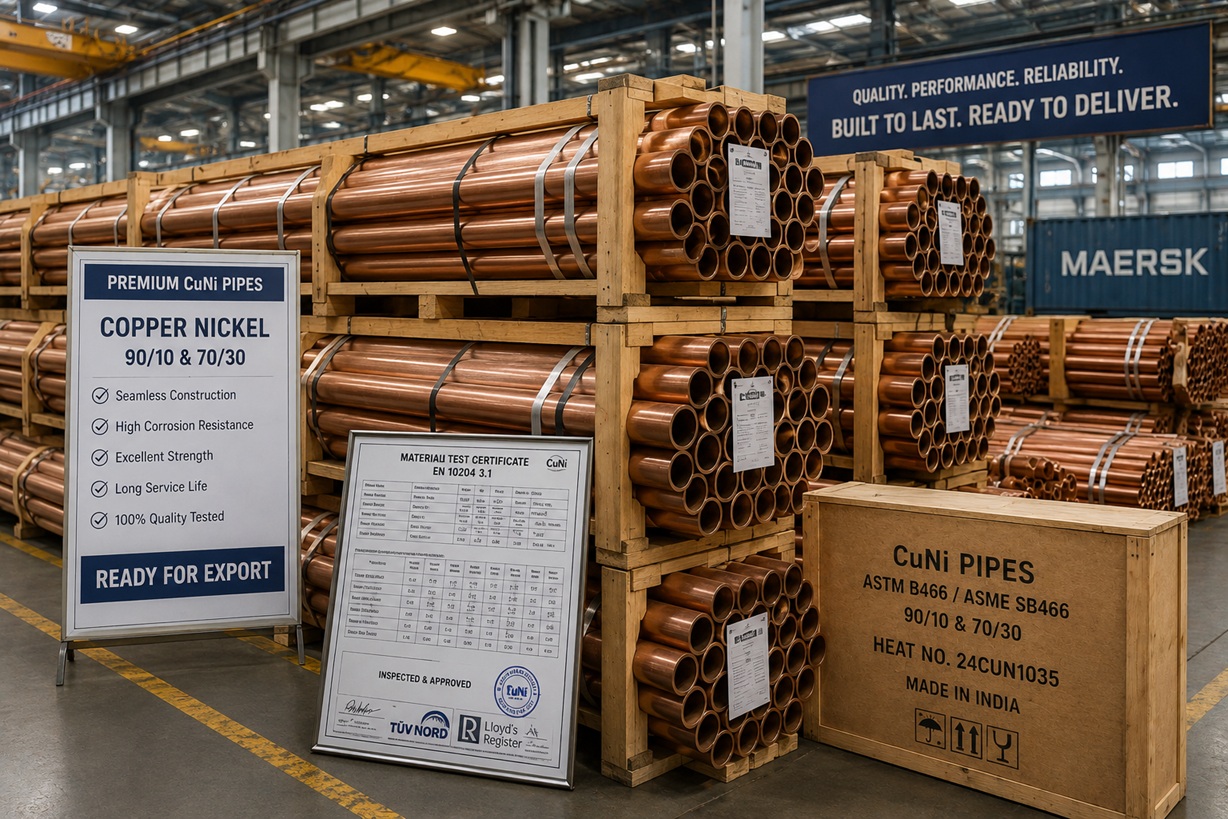
A reliable copper-nickel pipe manufacturer should provide full mill test certification confirming alloy composition, mechanical properties, and dimensional compliance with ASTM B466 or the relevant regional standard, along with traceability documentation linking each length of pipe back to its production batch, a requirement on most marine and offshore projects subject to classification society inspection.
For projects sourcing internationally, working with an established copper-nickel pipe exporter India-based buyers and shipyards already have experience with can simplify export documentation, classification society liaison, and logistics considerably. Whether the search is for a CuNi pipe manufacturer producing to a specific naval standard or a CuNi pipe supplier able to support an ongoing offshore maintenance contract, prioritizing certification, traceability, and sector-specific experience over price alone tends to prevent costly issues later in a project.
Frequently Asked Questions
What is the difference between copper-nickel 90/10 pipe and copper-nickel 70/30 pipe? 90/10 pipe contains roughly 90% copper and 10% nickel and offers strong, cost-effective corrosion resistance for general seawater service, while 70/30 pipe contains roughly 30% nickel, offering higher strength and better performance in high-velocity or more aggressive seawater conditions, at a higher cost.
What is ASTM B466 copper-nickel pipe used for? ASTM B466 governs seamless copper-nickel pipe and tube used in marine, offshore, and industrial seawater applications, specifying alloy composition, mechanical properties, and dimensional tolerances.
Why is copper-nickel pipe used for seawater applications instead of steel? Copper nickel pipe resists chloride-driven corrosion, erosion under flowing seawater, and biofouling far more effectively than carbon steel, resulting in a longer service life and lower long-term maintenance costs in marine environments.
What does "cupronickel pipe" mean, and is it different from copper nickel pipe"? Cupronickel is simply another name for the copper-nickel alloy; the terms are used interchangeably to describe the same family of corrosion-resistant piping material.
Why is seamless construction preferred for copper-nickel pipe? Seamless copper-nickel pipe has no welded longitudinal joint, removing a potential point of mechanical weakness and localized corrosion that's particularly important under the pressure, vibration, and corrosive exposure typical of marine service.
How does copper-nickel pipe resist biofouling? The alloy releases trace amounts of copper ions at its surface, which inhibit the attachment and growth of barnacles, mussels, algae, and other marine organisms that would otherwise restrict flow in seawater piping.
What should I confirm before ordering copper-nickel pipe for a project? Confirm the alloy grade (90/10 or 70/30), size and wall thickness, manufacturing standard (such as ASTM B466), and expected flow velocity and water chemistry, ideally with mill test certification from the manufacturer or supplier.
Conclusion
Copper-nickel pipe earns its place in marine and offshore engineering through a combination of properties few other materials can match: corrosion resistance, biofouling resistance, and reliable long-term performance under sustained seawater exposure. Understanding the practical differences between 90/10 and 70/30 grades, what ASTM B466 actually certifies, and why seamless construction matters puts you in a far stronger position to specify the right CuNi pipe for a marine, offshore, or industrial seawater project and to source it from a manufacturer or supplier who can back it with the certification these applications demand.