| Nominal Pipe Size (Inches) |
Type K | Type L | Type M | |||
|---|---|---|---|---|---|---|
| Weight (LBS/FT) by Type | Weight (LBS/FT) by Type | Weight (LBS/FT) by Type | ||||
| Wall Thickness (Inches) |
Weight (LBS/FT) |
Wall Thickness (Inches) |
Weight (LBS/FT) |
Wall Thickness (Inches) |
Weight (LBS/FT) |
|
| 1/4 | 0.035 | 0.127 | 0.030 | 0.110 | 0.028 | 0.103 |
| 3/8 | 0.049 | 0.221 | 0.035 | 0.158 | 0.032 | 0.143 |
| 1/2 | 0.049 | 0.284 | 0.040 | 0.210 | 0.035 | 0.186 |
| 3/4 | 0.065 | 0.466 | 0.045 | 0.330 | 0.042 | 0.292 |
| 1 | 0.065 | 0.610 | 0.050 | 0.436 | 0.045 | 0.389 |
| 1-1/4 | 0.065 | 0.759 | 0.050 | 0.546 | 0.050 | 0.546 |
| 1-1/2 | 0.072 | 0.994 | 0.050 | 0.665 | 0.050 | 0.665 |
| 2 | 0.083 | 1.489 | 0.060 | 1.098 | 0.058 | 1.065 |
| 2-1/2 | 0.095 | 2.165 | 0.070 | 1.613 | 0.070 | 1.613 |
| 3 | 0.109 | 2.973 | 0.080 | 2.163 | 0.083 | 2.244 |
| 4 | 0.125 | 4.853 | 0.090 | 3.341 | 0.095 | 3.693 |
| 5 | 0.156 | 7.764 | 0.110 | 5.444 | 0.110 | 5.444 |
| 6 | 0.188 | 11.130 | 0.125 | 7.591 | 0.125 | 7.591 |
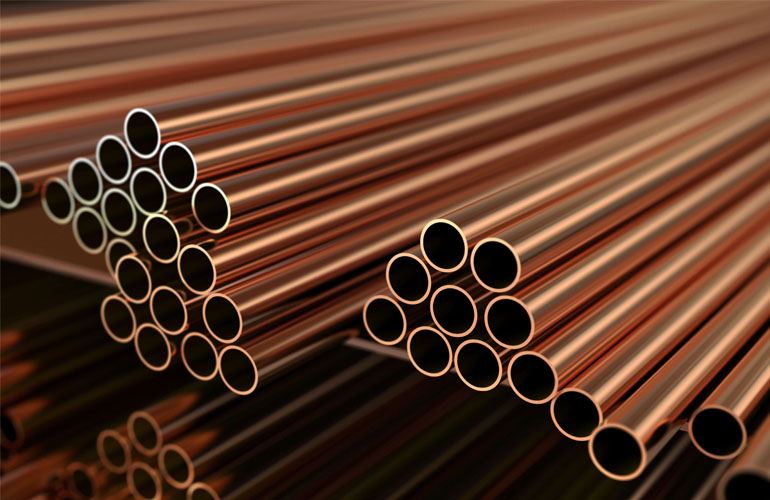
What is a Copper Pipe?
A copper pipe is a tube made from pure copper that is designed to transport liquids and gases in homes, commercial buildings, and industrial facilities. It is known for its exceptional strength, long service life, and resistance to corrosion caused by water and environmental conditions. Copper also offers excellent thermal conductivity, making it one of the best materials for heating and cooling systems.
Copper pipes are widely used in industries such as plumbing, HVAC, refrigeration, medical gas systems, shipbuilding, and manufacturing. Their ability to withstand high pressure and changing temperatures makes them ideal for carrying both hot and cold water safely and efficiently.
Although the terms copper pipe and copper tube are often used interchangeably, they are not exactly the same. In industrial applications, copper tubes are manufactured according to internationally recognized standards such as ASTM B88 and ASTM B280. These standards ensure accurate dimensions, consistent quality, and compatibility with a wide range of equipment and fittings.
One of the biggest advantages of seamless copper tubes is their manufacturing process. Since they are produced without welded joints, they provide superior strength and significantly reduce the risk of leakage. This makes them the preferred choice for refrigeration units, air conditioning systems, medical gas pipelines, and other high-performance applications.
Copper pipes are also easy to install, require very little maintenance, and can deliver reliable performance for decades. In addition, copper is a fully recyclable material, making it an environmentally responsible option for modern construction and industrial projects.
Whether you are constructing a residential building, a commercial facility, a manufacturing plant, or a marine vessel, copper pipes offer outstanding durability, reliability, and efficiency. Their ability to handle high pressure while providing excellent heat transfer makes them one of the most trusted piping solutions across multiple industries.
2. Types of Copper Pipes
Copper pipes are available in different types to suit residential, commercial and industrial applications. Each type is manufactured according to international standards to provide excellent durability, corrosion resistance and long-term performance.
01
ASTM B88 Copper Pipe
Used for plumbing, heating systems and fire protection. It is available in Type K, Type L and Type M for different pressure requirements.
02
ASTM B280 Copper Tube
Designed for refrigeration and air-conditioning systems with excellent heat transfer and long service life.
03
Medical Gas Copper Pipe
Manufactured under strict cleanliness standards for transporting oxygen, nitrous oxide and other medical gases safely.
04
HVAC Copper Pipe
Provides excellent thermal conductivity and pressure resistance for heating, ventilation and air-conditioning systems.
05
Plumbing Copper Pipe
Ideal for residential and commercial water supply systems because of its corrosion resistance and long service life.
06
Copper Pipe for Gas Line
Suitable for transporting fuel gases where approved, offering excellent pressure resistance and dependable performance.
07
Copper Pipe for LPG
Designed for LPG systems with superior flexibility, leak resistance and corrosion protection.
08
Copper Pipe for CNG Kit
Commonly used in natural gas-powered vehicles because it withstands high pressure and provides reliable fuel delivery.
09
Copper Pipe for Instrumentation
Used in industrial instrumentation and process control systems where accurate fluid and gas transmission is essential.
3. Copper Pipe Manufacturing Process
High-quality copper pipes are manufactured using advanced production methods and strict quality standards to ensure durability, precision, and reliable performance.
01
Raw Copper Selection
- High-purity copper is carefully selected.
- Ensures excellent conductivity and corrosion resistance.
02
Tube Formation
- Copper is heated and formed into seamless tubes.
- Provides higher strength and leak-free performance.
03
Cold Drawing & Sizing
- Tubes are drawn to precise dimensions.
- Maintains accurate wall thickness and diameter.
04
Surface Finishing
- Deburring and cleaning remove imperfections.
- Creates a smooth, defect-free surface.
05
Inspection & Testing
- Pressure, dimensional, and quality checks are performed.
- Ensures compliance with ASTM standards.
06
Packaging & Delivery
- Products are securely packed for transport.
- Protects pipes from damage during shipping.
4. Copper Pipe Specifications
Choosing the right copper pipe is essential for the efficiency, safety, and long-term performance of any piping system. Copper pipes are manufactured according to internationally recognized standards that define dimensions, wall thickness, tolerances, and performance characteristics. Understanding these specifications helps engineers, contractors, and buyers select the most suitable copper pipe for every application.
01
ASTM Standards
There are two primary standards for copper pipes: ASTM B88 and ASTM B280. These standards define pipe dimensions, wall thickness, manufacturing requirements, and intended applications to ensure reliable performance.
- ASTM B88 is widely used for plumbing, water supply, heating systems, and fire protection.
- ASTM B280 is specifically designed for refrigeration, air-conditioning, and HVAC systems.
- Choosing the correct ASTM standard helps engineers and contractors design piping systems that meet industry regulations and deliver long-term reliability.
ASTM B88 copper pipes are available in three wall thicknesses: Type K, Type L, and Type M. Each type is designed for different pressure ratings and installation environments.
- Type K – Heavy wall, ideal for underground water supply and industrial piping.
- Type L – Medium wall, commonly used for residential and commercial plumbing.
- Type M – Light wall, suitable for water supply and low-pressure plumbing systems.
ASTM B280 copper tubes are manufactured with strict dimensional tolerances and exceptional cleanliness. They provide leak-free performance, excellent thermal conductivity, and outstanding pressure resistance for HVAC and refrigeration systems.
02
Pipe Sizes & Dimensions
Copper pipe sizes vary depending on the applicable standard and intended application. Important dimensions include outside diameter, inside diameter, wall thickness, and pressure rating. These measurements directly affect flow capacity, operating pressure, and compatibility with fittings.
- Outside Diameter (OD)
- Inside Diameter (ID)
- Wall Thickness
- Pipe Weight
- Pressure Rating
A standard copper pipe size chart is generally used as a reference during system design. Actual dimensions may vary depending on the applicable ASTM standard and the manufacturer's specifications.
03
Manufacturing Tolerances
Manufacturing tolerance refers to the permitted variation in copper pipe dimensions while still complying with industry standards. Maintaining tight tolerances ensures reliable installation, leak-free joints, and consistent performance across every application.
- Ensures accurate fitment with standard fittings.
- Provides reliable sealing and leak-free performance.
- Maintains consistent outside diameter and wall thickness.
- Improves pressure handling and long-term durability.
- Every copper pipe undergoes inspection to verify compliance with ASTM standards.
Strict dimensional control allows copper pipes to perform consistently in plumbing, HVAC, refrigeration, industrial processing, and medical gas applications.
04
Quality Assurance
At Indigo Metals, copper pipes are manufactured according to internationally recognized quality standards. Every production stage is carefully monitored to ensure reliable performance and complete customer satisfaction.
- Advanced testing methods throughout production.
- Strict inspection procedures at every stage.
- Comprehensive quality documentation.
- Verification of dimensions and wall thickness.
- Pressure and performance testing before dispatch.
- Products manufactured to customer specifications and ASTM requirements.
This quality management system ensures that every copper pipe delivers excellent durability, corrosion resistance, dimensional accuracy, and long service life.
05
Selecting the Right Copper Pipe
Choosing the correct copper pipe size is essential for efficient fluid flow, pressure handling, and long-term system performance. Copper pipes are available in different nominal sizes and wall thicknesses to suit various industrial and commercial applications.
When selecting a copper pipe, consider the following technical factors:
- Outside Diameter (OD)
- Wall Thickness
- Operating Pressure
- Required Flow Rate
- Fluid or Gas Being Transported
- Installation Environment
- Temperature Range
- Applicable Industry Standards
- Pipe Length Requirements
- Future Maintenance Requirements
Proper pipe sizing improves system efficiency, reduces pressure loss, minimizes energy consumption, extends service life, and ensures compatibility with fittings and connected equipment. A standard copper pipe size chart can be used as a reference; however, actual dimensions may vary depending on the applicable standard and manufacturer.
5. Copper Pipe Size Guide by Application
The recommended copper pipe size varies depending on the application, flow requirements, and operating conditions. The table below provides a general reference for commonly used copper pipe sizes.
| Application | Recommended Copper Pipe Size |
|---|---|
| Residential Plumbing | 1/2" – 3/4" |
| Commercial Plumbing | 3/4" – 2" |
| HVAC Systems | 1/4" – 5/8" |
| Refrigeration | 1/4" – 7/8" |
| Medical Gas Systems | 1/2" – 2" |
| LPG & Gas Lines | 1/2" – 1" |
| Instrumentation | 1/4" – 1/2" |
Benefits of Copper Pipes
Copper pipes play a vital role in modern plumbing, HVAC, refrigeration, medical gas, and industrial piping systems. Moreover, their strength, corrosion resistance, excellent thermal conductivity, and long service life make them one of the most reliable piping solutions available today.
Manufactured to ASTM standards
Available in multiple sizes & wall thicknesses
Suitable for plumbing & HVAC systems
Used in refrigeration & medical gas applications
High pressure and corrosion resistance
Long-lasting and low maintenance
Therefore, selecting the correct copper pipe standard, pipe size, and wall thickness is essential for achieving safe operation, efficient fluid flow, and long-term system performance. Furthermore, by understanding copper pipe specifications, applications, and industry standards, engineers, contractors, and buyers can confidently choose the right solution for every project.
High Purity Copper
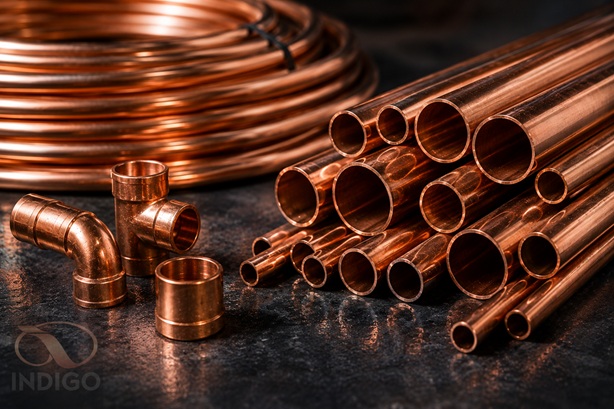

STANDARD COPPER PIPE SIZE CHART
According to ASTM B88 | Type K, L, M
| Nominal Size (Inches) |
Outside Diameter (OD) (Inches) |
Wall Thickness (Inches) | Weight (LBS/FT) | ||||
|---|---|---|---|---|---|---|---|
| Type K | Type L | Type M | Type K | Type L | Type M | ||
| 1/4 | 0.375 | 0.035 | 0.030 | 0.028 | 0.127 | 0.110 | 0.103 |
| 3/8 | 0.500 | 0.049 | 0.035 | 0.032 | 0.221 | 0.158 | 0.143 |
| 1/2 | 0.625 | 0.049 | 0.040 | 0.035 | 0.284 | 0.210 | 0.186 |
| 3/4 | 0.875 | 0.065 | 0.045 | 0.042 | 0.466 | 0.330 | 0.292 |
| 1 | 1.125 | 0.065 | 0.050 | 0.045 | 0.610 | 0.436 | 0.389 |
| 1-1/4 | 1.375 | 0.065 | 0.050 | 0.050 | 0.759 | 0.546 | 0.546 |
| 1-1/2 | 1.625 | 0.072 | 0.050 | 0.050 | 0.994 | 0.665 | 0.665 |
| 2 | 2.125 | 0.083 | 0.060 | 0.058 | 1.489 | 1.098 | 1.065 |
| 2-1/2 | 2.625 | 0.095 | 0.070 | 0.070 | 2.165 | 1.613 | 1.613 |
| 3 | 3.125 | 0.109 | 0.080 | 0.083 | 2.973 | 2.163 | 2.244 |
| 4 | 4.125 | 0.125 | 0.090 | 0.095 | 4.853 | 3.341 | 3.693 |
| 5 | 5.125 | 0.156 | 0.110 | 0.110 | 7.764 | 5.444 | 5.444 |
| 6 | 6.125 | 0.188 | 0.125 | 0.125 | 11.130 | 7.591 | 7.591 |
Notes
- The above dimensions are based on the requirements of ASTM B88 for Type K, Type L, and Type M copper water tubes.
- Actual dimensions and weights may vary slightly depending on manufacturing tolerances and applicable industry standards.
- Type K has the thickest wall and is recommended for underground service, industrial piping, and high-pressure applications.
- Type L is the most commonly used grade for residential and commercial plumbing, HVAC, and water distribution systems.
- Type M has the thinnest wall and is generally suitable for low-pressure plumbing applications where permitted by local codes.
- Always verify the required pipe size, wall thickness, and pressure rating before selecting copper tubes for your application.
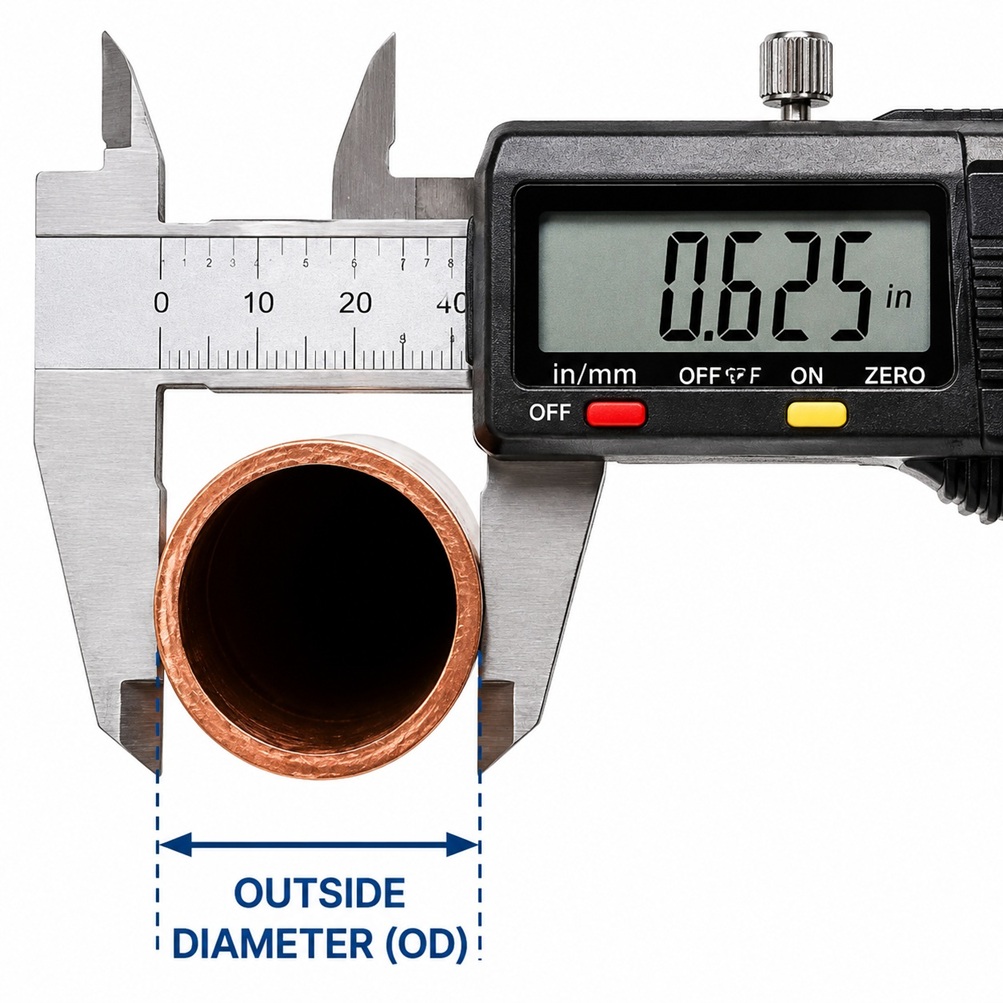
Copper Pipe Outside Diameter Measurement
Standard Pipe Sizes According to ASTM B88
Outside Diameter (OD) Measurement
The outside diameter (OD) of a copper pipe is measured across the outer surface of the pipe.
Standard Copper Pipe Size Chart (ASTM B88)
| Nominal Pipe Size (Inches) |
Outside Diameter (OD) (Inches) |
Outside Diameter (OD) (MM) |
|---|---|---|
| 1/4 | 0.375 | 9.52 |
| 3/8 | 0.500 | 12.70 |
| 1/2 | 0.625 | 15.88 |
| 3/4 | 0.875 | 22.23 |
| 1 | 1.125 | 28.58 |
| 1-1/4 | 1.375 | 34.93 |
| 1-1/2 | 1.625 | 41.28 |
| 2 | 2.125 | 53.98 |
| 2-1/2 | 2.625 | 66.68 |
| 3 | 3.125 | 79.38 |
| 4 | 4.125 | 104.78 |
| 5 | 5.125 | 130.18 |
| 6 | 6.125 | 155.58 |
Measurement Notes
- Outside Diameter (OD) is measured across the outer surface of the copper pipe.
- OD remains constant for a given nominal pipe size regardless of wall thickness.
- The values shown are based on ASTM B88 standard copper water tubes.
- Wall thickness varies according to Type K, Type L, and Type M, while the outside diameter remains the same.
- Actual dimensions may vary slightly according to manufacturing tolerances and applicable industry standards.
- Always verify the required pipe specification before selecting copper tubes for plumbing, HVAC, refrigeration, medical gas, or industrial applications.
Copper Pipe Weight Comparison
Compare Weight (LBS/FT) of Standard Copper Pipes
According to ASTM B88
Disclaimer: The above values are intended as a general engineering reference. Always verify dimensions, wall thickness, and weight with the latest manufacturer's catalogue before selecting copper pipes for plumbing, HVAC, refrigeration, medical gas, or industrial applications.
Why Choose Indigo Metals?
At Indigo Metals, we supply premium-quality copper pipes in a wide range of sizes to meet the requirements of residential, commercial, and industrial applications. Every pipe is carefully inspected to ensure dimensional accuracy, consistent quality, and dependable performance.
Wide Size Range
Available in multiple sizes for diverse applications.
Quality Inspected
Every copper pipe is checked before delivery.
Industry Expertise
Guidance from experienced piping specialists.
Reliable Supply
Fast delivery with consistent product availability.
Applications We Support
- Heating, Ventilation & Air Conditioning (HVAC)
- Residential & Commercial Plumbing
- Refrigeration Systems
- Medical Gas Installations
- Industrial Process Piping
- Custom Copper Pipe Requirements
6. Copper Pipe Grades
The performance of a copper piping system depends on the quality and grade of copper used during manufacturing. Different copper grades offer unique properties such as strength, thermal conductivity, corrosion resistance, and durability, making them suitable for a wide range of industrial applications.
Material Quality
High-Purity Copper
Copper pipes are typically manufactured using copper with a minimum purity of 99.90%. This high level of purity provides outstanding corrosion resistance, excellent thermal conductivity, and dependable long-term performance in demanding environments.
Performance
Designed for Critical Applications
The copper grade selected depends on the operating pressure, service temperature, installation conditions, and intended application. Choosing the correct material ensures reliable operation and extends the service life of the piping system.
Applications
Used Across Multiple Industries
High-quality copper tubes are widely used in plumbing, HVAC systems, refrigeration, medical gas installations, heating and cooling networks, and industrial process piping because of their strength and excellent heat transfer properties.
Next Section
Common Copper Grades Used for Pipes & Tubes
Several copper grades are commonly used to manufacture pipes and tubes. Each grade offers specific mechanical and physical characteristics, making it suitable for particular applications and operating conditions.
How to Select the Right Copper Grade
Selecting the right copper grade is essential for achieving reliable performance, long service life, and maximum efficiency. Consider the following factors before choosing a copper pipe material.
Consider the operating pressure the pipe will be subjected to.
Evaluate the temperature range in which the pipe will operate.
Identify the fluid or gas that will flow through the piping system.
Assess the surrounding environment and potential corrosion exposure.
Ensure compliance with applicable industry standards and specifications.
Determine the required mechanical strength for the application.
Consider the required thermal conductivity for efficient heat transfer.
Review installation methods and compatibility with fittings.
Estimate the expected service life and long-term maintenance requirements.
C12200 – The Preferred Copper Grade
For most plumbing, heating and cooling, HVAC, refrigeration, and medical gas applications, C12200 copper is the preferred choice. It offers excellent corrosion resistance, high mechanical strength, outstanding thermal conductivity, and dependable long-term performance, making it one of the most widely used copper grades for industrial and commercial piping systems.
Why Copper Grades Matter
The grade of copper used in a piping system directly affects its strength, corrosion resistance, thermal conductivity, and service life. Therefore, selecting the right copper grade helps ensure reliable performance across plumbing, HVAC, refrigeration, medical gas, and industrial applications.
High Strength
Supports demanding industrial and commercial applications.
Corrosion Resistance
Provides long-term protection in challenging environments.
Excellent Conductivity
Delivers superior thermal and electrical performance.
Long Service Life
Reduces maintenance and improves system reliability.
Industry Insight
from Indigo Metals
At Indigo Metals, we manufacture premium-quality copper pipes and tubes using high-purity copper. Moreover, every product undergoes strict inspection and quality testing to ensure compliance with industry standards. As a result, our customers can rely on durable, high-performance copper piping solutions for plumbing, HVAC, refrigeration, medical gas, and industrial process applications.
7. Copper Pipe Applications
Copper pipes are widely used across residential, commercial, and industrial sectors because of their excellent corrosion resistance, high thermal conductivity, strength, and long service life. As a result, they are suitable for transporting water, refrigerants, gases, and process fluids under demanding operating conditions
7.1
Heating & Cooling Applications
Copper pipes are widely used in heating and cooling systems because of their excellent thermal conductivity, pressure resistance, and long service life. As a result, they improve heat transfer efficiency while minimizing maintenance and reducing the risk of leakage.
- Heating Water Circulation
- Chilled Water Systems
- Condenser Connections
- Evaporator Coils
- Commercial Air-Conditioning Systems
- Central HVAC Installations
Copper pipes are lightweight, easy to install, naturally corrosion resistant, and capable of operating under demanding pressure and temperature conditions. Therefore, they are an ideal solution for modern HVAC systems.
7.2
Refrigeration Applications
Copper refrigeration tubes are specially manufactured to transport refrigerants safely and efficiently. As a result, their seamless construction, excellent thermal conductivity, and high pressure resistance make them the preferred choice for commercial and industrial refrigeration systems.
- Cold Storage Facilities
- Commercial Refrigeration
- Ice Plants
- Display Refrigeration Units
- Industrial Cooling Systems
- Food Preservation Equipment
- Beverage Cooling Systems
- Walk-in Freezers
Seamless copper tubes minimize the risk of leakage, improve energy efficiency, and, therefore, provide reliable long-term performance in demanding refrigeration environments.
7.3
Medical Gas Systems
Medical gas copper pipes are specially manufactured for hospitals and healthcare facilities where cleanliness, safety, and reliability are essential. Therefore, these pipes are thoroughly cleaned, degreased, and tested to ensure contamination-free gas distribution.
- Oxygen Distribution Systems
- Medical Air Lines
- Nitrous Oxide Supply
- Vacuum Systems
- Surgical Gas Networks
- Healthcare Facilities
- Laboratories
- Emergency Care Units
Medical copper pipes provide oil-free and degreased internal surfaces, outstanding corrosion resistance, leak-proof performance, and full compliance with medical gas standards. As a result, these qualities help maintain patient safety and ensure uninterrupted gas delivery.
7.4
Plumbing Systems
Copper pipes have been the preferred choice for plumbing systems for decades because they offer excellent strength, corrosion resistance, and hygienic water transportation. As a result, their smooth internal surface helps maintain water quality while ensuring reliable long-term performance.
- Residential Water Supply
- Commercial Buildings
- Hotels
- Hospitals
- Educational Institutions
- High-Rise Developments
- Domestic Hot Water Systems
- Cold Water Distribution
Copper naturally resists bacterial growth, maintains clean drinking water, and requires very little maintenance. As a result, it is one of the most trusted materials for modern plumbing systems.
7.5
Oil & Gas Industry
Copper pipes are widely used in the oil and gas sector because of their high pressure capability, dimensional accuracy, and corrosion resistance. As a result, they perform reliably in demanding industrial environments where precision and durability are essential.
- Instrument Air Systems
- Pressure Gauge Connections
- Process Analyzers
- Hydraulic Control Systems
- Offshore Platforms
- Refineries
- Petrochemical Plants
- Instrumentation Tubing
Their excellent corrosion resistance, strength, and reliability make copper pipes suitable for critical instrumentation and process control applications across the oil and gas industry. As a result, they are widely trusted for demanding industrial operations.
7.6
Marine Industry
Copper pipes are widely used in marine applications because they offer outstanding resistance to seawater corrosion and harsh environmental conditions. As a result, their durability and long service life make them ideal for shipbuilding and offshore installations.
- Shipbuilding
- Offshore Platforms
- Seawater Cooling Systems
- Fire Protection Systems
- Desalination Plants
- Marine HVAC Systems
- Ballast Water Systems
- Engine Cooling Circuits
Copper pipes require minimal maintenance, resist corrosion in saltwater environments, and, therefore, provide dependable performance throughout their service life, reducing operational costs for marine applications.
7.7
Chemical Industry
Chemical processing facilities require piping systems that can withstand aggressive chemicals and varying temperatures. Therefore, copper pipes provide excellent chemical stability, corrosion resistance, and efficient heat transfer for a wide range of industrial processes.
- Chemical Transfer Lines
- Process Cooling Systems
- Heat Exchangers
- Laboratory Installations
- Utility Piping
- Instrumentation Systems
- Chemical Processing Units
- Industrial Fluid Distribution
With excellent thermal conductivity and reliable mechanical performance, copper pipes help improve efficiency, safety, and reliability in chemical processing applications. Therefore, they provide a dependable solution for a wide range of industrial operations.
7.8
Food Processing Industry
Copper pipes are widely used in food processing plants because they provide hygienic fluid transfer, excellent corrosion resistance, and efficient heat transfer. As a result, their smooth internal surface minimizes contamination and simplifies cleaning, making them ideal for sanitary processing environments. Furthermore, they support reliable performance in hygienic applications.
- Dairy Processing Plants
- Beverage Production
- Brewing Systems
- Water Purification Plants
- Process Cooling Systems
- Heat Exchangers
- Steam Distribution
- Food Manufacturing Facilities
The non-porous internal surface of copper pipes supports hygienic operation, reduces bacterial growth, and helps maintain product quality throughout food processing applications. Therefore, it is well suited for sanitary processing environments.
7.9
Power Plants
Power generation facilities require piping systems capable of operating under high temperatures and pressures. Therefore, copper pipes provide excellent thermal conductivity, mechanical strength, and long-term reliability for critical cooling and heat transfer applications.
- Condenser Systems
- Heat Exchangers
- Cooling Water Circuits
- Steam Auxiliary Systems
- Turbine Cooling
- Instrumentation Lines
- Process Water Distribution
- Power Generation Equipment
Their superior heat transfer capability improves energy efficiency while ensuring dependable performance in demanding power plant operations. Therefore, they are an ideal choice for critical power generation applications.
Copper Pipe Applications Across Industries
Copper pipes are used across a wide range of industries because of their durability, corrosion resistance, excellent thermal conductivity, and long service life. The table below highlights common applications and the recommended industry standards.
| Industry | Primary Application | Recommended Standard |
|---|---|---|
| HVAC | Refrigerant Lines | ASTM B280 |
| Refrigeration | Cooling Systems | ASTM B280 |
| Medical | Oxygen & Medical Gas | ASTM B819 |
| Plumbing | Water Distribution | ASTM B88 |
| Oil & Gas | Instrumentation Systems | ASTM B280 |
| Marine | Seawater Systems | Copper Alloy Standards |
| Chemical | Process Piping | ASTM Standards |
| Food Processing | Hygienic Fluid Transfer | ASTM B88 |
| Power Plants | Heat Exchange & Cooling | ASTM Standards |
8. Advantages of Copper Pipe
Copper pipes are widely used in residential, commercial, and industrial applications because they offer exceptional durability, corrosion resistance, thermal efficiency, and long-term reliability. Their ability to withstand demanding operating conditions while requiring minimal maintenance makes them one of the most trusted piping solutions across multiple industries.
8.1
Excellent Corrosion Resistance
Copper pipes naturally develop a protective oxide layer when exposed to air, helping them resist corrosion even in demanding environments. This protective layer extends service life, reduces maintenance requirements, and ensures dependable long-term performance.
- Plumbing Systems
- HVAC Installations
- Refrigeration Plants
- Marine Environments
- Chemical Processing
- Medical Gas Pipelines
Outstanding corrosion resistance makes copper pipes one of the most reliable choices for applications where durability, safety, and long-term performance are essential.
8.2
Superior Thermal Conductivity
Copper is one of the most efficient heat-conducting metals used in piping systems. Its excellent thermal conductivity enables faster heat transfer, improves energy efficiency, and ensures consistent performance in heating and cooling applications.
- Air Conditioning Systems
- Refrigeration Equipment
- Heat Exchangers
- Water Heating Systems
- Chilled Water Networks
- Industrial Cooling Systems
Because copper transfers heat quickly and efficiently, it helps reduce energy consumption, improves equipment performance, and supports long-term operational reliability across commercial and industrial installations.
8.3
Long Service Life
Copper pipes are engineered to deliver reliable performance for decades. Their natural resistance to corrosion, UV exposure, and temperature fluctuations allows them to maintain structural integrity and reduce replacement costs over the long term.
- Designed for Long-Term Performance
- Excellent Weather Resistance
- Withstands Temperature Variations
- Resists UV Exposure
- Reduces Replacement Costs
- Low Lifecycle Cost
When installed correctly and maintained properly, copper piping systems provide dependable operation with minimal downtime, making them a cost-effective investment for residential, commercial, and industrial projects.
8.4
High Pressure & Temperature Resistance
Copper pipes are capable of operating under demanding pressure and temperature conditions without compromising performance. Their excellent mechanical strength makes them suitable for critical industrial and commercial piping systems.
- Oil & Gas Industry
- Power Generation Plants
- HVAC Installations
- Medical Gas Systems
- Chemical Processing Plants
- Industrial Utility Networks
The combination of strength, durability, and thermal stability enables copper pipes to perform reliably in applications where safety, efficiency, and long-term service life are essential.
8.7
Eco-Friendly & Recyclable
Copper is one of the most sustainable engineering materials available. It can be recycled repeatedly without losing its mechanical, thermal, or corrosion-resistant properties, making it an environmentally responsible choice for modern piping systems.
- 100% Recyclable Material
- Supports Sustainable Construction
- Reduces Raw Material Consumption
- Lower Environmental Impact
- Maintains Original Material Properties
- Suitable for Green Building Projects
Using recyclable copper pipes helps reduce waste, conserve natural resources, and support environmentally friendly construction practices while maintaining exceptional performance.
8.8
Low Maintenance
Copper pipes require very little maintenance throughout their service life. Their resistance to corrosion, leakage, and wear minimizes repair requirements, reduces operational downtime, and lowers long-term maintenance costs.
- Reduced Maintenance Costs
- Leak-Resistant Performance
- Excellent Corrosion Resistance
- Long-Term Reliability
- Lower Operating Expenses
- Extended System Life
The combination of durability and reliability makes copper piping systems a cost-effective investment for residential, commercial, and industrial applications where uninterrupted performance is essential.
Key Advantages at a Glance
Corrosion Resistance
Longer Service Life & Reduced Maintenance
High Thermal Conductivity
Efficient Heat Transfer & Energy Savings
Pressure Resistance
Reliable Performance in Industrial Applications
Hygienic Material
Safe for Potable Water & Medical Gas Systems
Easy Installation
Faster Installation & Lower Labour Costs
Low Maintenance
Reduced Operating & Repair Expenses
100% Recyclable
Environmentally Friendly & Sustainable
Why Industries Prefer Copper Pipes
Copper pipes continue to be the preferred choice across residential, commercial, and industrial sectors because they deliver exceptional durability, efficient heat transfer, excellent corrosion resistance, and dependable long-term performance. Their ability to perform under demanding operating conditions makes them suitable for critical piping systems where reliability and safety are essential.
✔ Long Service Life
✔ Excellent Corrosion Resistance
✔ High Thermal Conductivity
✔ Reliable Under High Pressure
✔ Easy Installation
✔ Low Maintenance Costs
INDUSTRY INSIGHT
Why Choose Indigo Metals?
At Indigo Metals, we manufacture premium-quality copper pipes and tubes that are engineered for long-term reliability and consistent performance. Every product undergoes strict dimensional inspection, quality testing, and compliance verification to ensure it meets international industry standards.
Our copper piping solutions are trusted across HVAC, plumbing, refrigeration, medical gas, power generation, marine, and industrial processing applications.
Request a Quote9. Copper Pipe vs Copper Tube
Although the terms copper pipe and copper tube are often used interchangeably, they are manufactured to different dimensional standards and are designed for different applications. Understanding these differences helps engineers, contractors, and buyers choose the right product for every project.
Copper Pipe
Manufacturing
Copper pipes are generally manufactured according to Nominal Pipe Size (NPS), making them suitable for plumbing, water supply, fire protection, gas distribution, and industrial utility systems.
Common Applications
- Water Supply Systems
- Residential & Commercial Plumbing
- Fire Protection Networks
- Gas Distribution Systems
- Industrial Utility Piping
Common Standards
- ASTM B88
- ASTM B306
Flexibility
Copper pipes are comparatively rigid, making them ideal for straight piping runs, permanent installations, and water distribution systems where structural strength is important.
Pressure Performance
Copper pipes provide excellent pressure resistance when manufactured to ASTM standards. Their performance depends on wall thickness, pipe size, operating pressure, and service temperature.
Copper Tube
Manufacturing
Copper tubes are manufactured using their Actual Outside Diameter (OD). They are produced with tighter dimensional tolerances, making them suitable for precision engineering applications.
Common Applications
- Refrigeration Systems
- HVAC Installations
- Medical Gas Pipelines
- Heat Exchangers
- Instrumentation Systems
- Industrial Processing
Common Standards
- ASTM B280
- ASTM B819
- ASTM B68
Flexibility
Copper tubes are more flexible than copper pipes, allowing them to be bent with fewer fittings. This simplifies installation and makes them the preferred choice for refrigeration, HVAC, and precision piping systems where multiple directional changes are required.
Pressure Performance
Copper tubes offer excellent pressure resistance when manufactured to the appropriate ASTM standards. Their performance depends on wall thickness, outside diameter, material grade, and operating temperature, making them suitable for demanding industrial applications.
Quick Comparison
| Feature | Copper Pipe | Copper Tube |
|---|---|---|
| Measurement | Nominal Pipe Size (NPS) | Actual Outside Diameter (OD) |
| Common Standards | ASTM B88, ASTM B306 | ASTM B280, ASTM B819, ASTM B68 |
| Primary Applications | Plumbing, Water Supply, Fire Protection | HVAC, Refrigeration, Medical Gas |
| Flexibility | Moderate | High |
| Precision | Standard | High |
| Installation | General Plumbing Systems | Precision Industrial Systems |
Which One Should You Choose?
Choosing between a copper pipe and a copper tube depends on the intended application, operating conditions, and industry requirements. Selecting the correct product improves installation efficiency, system performance, and long-term reliability.
Choose Copper Pipe
Ideal for general piping systems where durability and structural strength are the primary requirements.
- Water Distribution Systems
- Residential & Commercial Plumbing
- Fire Protection Networks
- Industrial Utility Piping
- Gas Distribution Systems
Choose Copper Tube
Best suited for precision applications that require accurate dimensions, flexibility, and efficient heat transfer.
- Refrigeration Systems
- HVAC Installations
- Medical Gas Pipelines
- Instrumentation Systems
- Heat Exchangers
Final Recommendation
Both copper pipes and copper tubes provide excellent corrosion resistance, durability, and long service life when manufactured to the appropriate standards. The right choice depends on your application's dimensional requirements, operating pressure, installation method, and industry specifications.
At Indigo Metals, we manufacture and supply high-quality copper pipes and copper tubes that comply with international standards, ensuring dependable performance for plumbing, HVAC, refrigeration, medical gas, industrial processing, and utility applications.
Why Choose Indigo Metals?
Indigo Metals manufactures premium-quality copper pipes and copper tubes that meet the requirements of modern industries. Every product is produced using high-purity raw materials and undergoes strict quality inspections to ensure consistent dimensions, dependable performance, and long service life.
Our products are manufactured in accordance with internationally recognized standards, making them suitable for plumbing, HVAC, refrigeration, medical gas systems, industrial processing, and utility applications. Whether you need standard sizes or project-specific solutions, our team helps you select the right copper piping products based on application, dimensions, operating conditions, and industry requirements.
With a strong focus on quality, reliability, and customer satisfaction, Indigo Metals continues to supply copper piping solutions that deliver outstanding performance across diverse industries worldwide.
Why Customers Trust Us
- High-purity copper pipes and tubes
- Manufactured to international standards
- Consistent quality and dimensional accuracy
- Strict quality inspection and testing
- Reliable supply for industrial applications
- Technical support for product selection
- Solutions for plumbing, HVAC, refrigeration, medical gas, and process industries
10. Copper Pipe Comparison
Selecting the right pipe material is essential for achieving reliable performance, long service life, and cost-effective installation. Copper pipes, stainless steel pipes, and PVC pipes each offer unique advantages depending on the operating conditions, application requirements, and industry standards.
Copper Pipe vs Stainless Steel Pipe
Although both copper pipes and stainless steel pipes are highly durable and corrosion resistant, they are designed for different applications. Copper pipes provide outstanding thermal conductivity, making them ideal for plumbing, heating, cooling, and refrigeration systems. Stainless steel pipes offer superior mechanical strength and perform exceptionally well in demanding industrial environments, including chemical processing, food manufacturing, and marine applications.
Feature
Copper Pipe
Stainless Steel Pipe
Thermal Conductivity
★★★★★
Excellent
★★★☆☆
Good
Corrosion Resistance
★★★★★
Excellent
★★★★★
Excellent
Weight
Lightweight
Heavy
Installation
Easy
Requires Skilled Installation
Maintenance
Low
Low
Initial Cost
Moderate
Higher
Heat Transfer
★★★★★
Excellent
★★★☆☆
Good
Plumbing Systems
★★★★★
Highly Recommended
★★★★☆
Suitable
HVAC Systems
★★★★★
Best Choice
★★☆☆☆
Limited Use
Refrigeration
★★★★★
Preferred
★☆☆☆☆
Rarely Used
Which Material Should You Choose?
Copper Pipe
Choose Copper Pipe When You Need
- Excellent heat transfer performance
- Plumbing & potable water systems
- HVAC installations
- Refrigeration piping
- Easy installation and maintenance
- Moderate installation cost
- Long-term corrosion resistance
- Medical gas applications
Stainless Steel Pipe
Choose Stainless Steel Pipe When You Need
- High mechanical strength
- Very high temperature resistance
- Chemical processing plants
- Food & beverage industries
- Marine applications
- Heavy-duty industrial systems
- Aggressive operating environments
- Pressure-intensive applications
Expert Recommendation
For plumbing, HVAC, refrigeration, and medical gas systems, copper pipes remain the preferred solution because they provide superior heat transfer, excellent corrosion resistance, lower installation costs, and outstanding long-term reliability. Stainless steel pipes are generally selected for heavy industrial environments where exceptional mechanical strength and resistance to extreme operating conditions are the primary requirements.
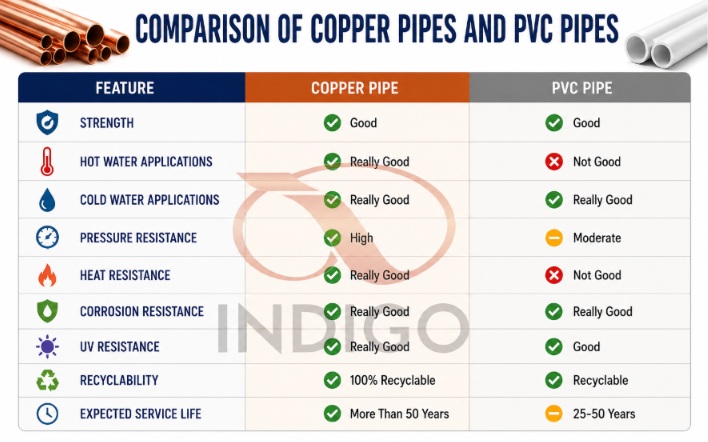
Copper Pipe vs PVC Pipe
Copper pipes and PVC pipes are both widely used for fluid transportation, but they are designed for different operating conditions. Copper pipes provide superior pressure resistance, excellent thermal performance, and exceptional durability, while PVC pipes are lightweight, economical, and commonly used for cold-water and low-temperature applications.
Feature
Copper Pipe
PVC Pipe
Strength
★★★★★
Excellent
★★★☆☆
Good
Hot Water Applications
★★★★★
Highly Suitable
★★☆☆☆
Limited
Cold Water Applications
★★★★★
Excellent
★★★★★
Excellent
Pressure Resistance
★★★★★
High
★★★☆☆
Moderate
Heat Resistance
★★★★★
Excellent
★★☆☆☆
Low
Corrosion Resistance
★★★★★
Excellent
★★★★★
Excellent
UV Resistance
★★★★★
Excellent
★★★★☆
Good
Installation
Requires Brazing / Soldering
Simple Adhesive Joining
Recyclability
100% Recyclable
Recyclable
Expected Service Life
More Than 50 Years
25–50 Years
Comparison Summary
Copper pipes provide outstanding durability, pressure resistance, thermal conductivity, and long-term reliability, making them ideal for plumbing, HVAC, refrigeration, and hot water systems. PVC pipes are lightweight, economical, and easy to install, making them suitable for cold-water distribution and low-temperature applications where budget is a primary consideration.
Which Pipe Should You Choose?
Copper Pipe
Choose Copper Pipe When You Need
Copper pipes are the ideal choice when your project requires long-term durability, superior heat transfer, and dependable performance under demanding operating conditions.
- High pressure applications
- Hot water distribution systems
- Excellent corrosion resistance
- Long service life
- Plumbing installations
- HVAC & Refrigeration Systems
- Medical Gas Applications
- Environmentally friendly piping solutions
PVC Pipe
Choose PVC Pipe When You Need
PVC pipes are suitable for lightweight, low-cost piping systems where high temperatures and extreme pressure are not primary requirements.
- Residential drainage systems
- Cold water supply
- Irrigation systems
- Low-pressure applications
- Quick installation
- Budget-friendly projects
- Lightweight piping
- General utility lines
INDUSTRY EXPERTISE
Request a Free Quote
Why Choose Indigo Metals?
At Indigo Metals, we help customers select the most suitable piping solution for every application. Our premium-quality copper pipes and copper tubes are manufactured to internationally recognized standards, ensuring exceptional durability, dimensional accuracy, and reliable long-term performance.
Whether your project involves plumbing, HVAC systems, refrigeration, medical gas installations, or industrial process piping, our experienced team provides expert guidance to help you choose the right copper piping solution based on operating conditions, industry standards, and project requirements.
✓ High-Purity Copper
✓ International Standards
✓ Strict Quality Inspection
✓ Technical Support
✓ Reliable Supply
✓ Long Service Life
11. Copper Pipe Fittings
Copper pipe fittings are essential components used to connect, redirect, reduce, branch, or terminate copper piping systems. Manufactured from high-quality copper, these fittings provide excellent corrosion resistance, leak-proof connections, and long service life. They are widely used in plumbing, HVAC, refrigeration, medical gas, and industrial piping applications where reliability and performance are critical.
Copper Elbow
A copper elbow is used to change the direction of a copper piping system while maintaining smooth fluid flow. It is commonly available in 45°, 90°, and long-radius configurations to suit different piping layouts.
- Water Supply Systems
- HVAC Installations
- Refrigeration Piping
- Heating Systems
- Industrial Process Lines
- Smooth Flow with Minimal Pressure Loss
Copper Tee
A copper tee is designed to divide or combine the flow of liquids and gases within a piping system. With one inlet and two outlets, it creates reliable branch connections for residential, commercial, and industrial piping networks.
- Plumbing Systems
- HVAC Distribution
- Industrial Piping
- Branch Connections
- Flow Distribution
- High Mechanical Strength
Copper Coupling
A copper coupling is used to connect two sections of copper pipe or copper tube, creating a secure and leak-proof joint. It is available in standard and reducing designs to accommodate different pipe sizes and is widely used for new installations, extensions, and repair work.
- Pipe Extensions
- System Repairs
- New Installations
- Industrial Process Piping
- Reliable Leak-Proof Connections
- Long Service Life
Copper Reducer
A copper reducer connects pipes of different diameters, allowing a smooth transition in flow capacity while minimizing turbulence and pressure loss. It improves overall system efficiency and ensures balanced fluid distribution.
- HVAC Systems
- Water Distribution Networks
- Industrial Process Lines
- Smooth Flow Transition
- Reduced Pressure Loss
- Improved System Efficiency
Copper Union
A copper union is a detachable fitting that allows sections of a piping system to be disconnected and reconnected without cutting the pipe. It simplifies inspection, maintenance, repairs, and equipment replacement while maintaining a secure, leak-proof connection.
- Equipment Connections
- Pumps & Valves
- Industrial Machinery
- Maintenance Access
- Reusable Connections
- Quick System Disassembly
Copper End Cap
A copper end cap is designed to seal the end of a copper pipe or tube, preventing leakage and protecting unused pipeline sections. It is commonly used during pressure testing, temporary closures, and future pipeline expansion projects.
- Pipeline Termination
- Temporary Sealing
- Pressure Testing
- Future Pipeline Expansion
- Leak Prevention
- Corrosion Resistant Sealing
Copper Compression Fittings
Copper compression fittings create strong mechanical joints without the need for soldering or brazing. Using a compression nut and ferrule, they provide reliable, leak-proof connections while allowing quick installation and future maintenance.
- Water Supply Systems
- Gas Distribution Lines
- Instrumentation Systems
- Repair & Maintenance Work
- No Heating Required
- Ideal for Confined Spaces
Copper Brazing Fittings
Copper brazing fittings are joined using high-temperature filler metals to produce exceptionally strong, leak-resistant joints. They are ideal for systems operating under high pressure and elevated temperatures.
- HVAC Systems
- Refrigeration Plants
- Industrial Gas Lines
- Medical Gas Installations
- Excellent Pressure Resistance
- Long Service Life
Copper Solder Fittings
Copper solder fittings are connected using lower-temperature solder alloys, making them a popular solution for plumbing and domestic water systems. They provide dependable sealing while keeping installation simple and cost-effective.
- Residential Plumbing
- Potable Water Systems
- Heating Systems
- Commercial Buildings
- Easy Installation
- Reliable Long-Term Performance
Common Copper Pipe Fittings
Copper piping systems use different types of fittings to connect, redirect, reduce, branch, and terminate pipelines. Each fitting is designed for a specific purpose, ensuring reliable flow, leak-proof performance, and long service life across plumbing, HVAC, refrigeration, medical gas, and industrial applications.
Copper Elbow
Changes the direction of fluid flow.
Copper Tee
Creates branch connections in piping systems.
Copper Coupling
Joins two copper pipes securely.
Copper Reducer
Connects pipes of different diameters.
Copper Union
Allows quick disassembly for maintenance.
Copper End Cap
Seals pipe ends and prevents leakage.
Compression Fittings
Mechanical joints without soldering.
Brazing Fittings
High-strength joints for demanding applications.
Solder Fittings
Reliable joints for plumbing systems.
INDUSTRY INSIGHT
Request a Quote
Why Choose Indigo Metals?
At Indigo Metals, we supply a comprehensive range of premium-quality copper pipe fittings engineered for dependable performance across plumbing, HVAC, refrigeration, medical gas, and industrial piping systems. Every fitting is manufactured with precision and undergoes strict quality inspections to ensure dimensional accuracy, corrosion resistance, and leak-proof performance.
✓ Premium Quality Copper
✓ Precision Manufacturing
✓ Leak-Proof Performance
✓ Corrosion Resistance
✓ International Standards
✓ Industrial-Grade Reliability
12. Copper Pipe Installation Guide
Proper copper pipe installation is essential for achieving maximum system performance, safety, and long service life. Following correct installation procedures minimizes leakage, improves efficiency, and ensures compliance with international piping standards.
Professional Installation Matters
Before installing any copper piping system, verify that the selected copper pipe meets the required dimensions, pressure ratings, and applicable ASTM standards. The installation area should be clean, dry, and free from dust or contaminants to ensure secure and reliable joints throughout the piping network.
Installation Process
A successful copper pipe installation follows a systematic process that ensures reliable joints, leak-free performance, and long-term durability.
01
Planning
Review drawings, verify specifications, and prepare all required materials before starting installation.
➜
02
Measuring
Measure pipe lengths accurately to minimize material waste and ensure proper fitment.
➜
03
Cutting
Cut copper pipes using appropriate cutting tools to obtain clean and accurate pipe ends.
➜
04
Deburring
Remove internal and external burrs to improve flow and prevent damage during installation.
➜
05
Joining
Join the pipes using soldering, brazing, or compression fittings according to application requirements.
➜
06
Pressure Testing
Perform pressure testing to verify leak-proof joints and confirm the system is ready for operation.
13. Copper Pipe Maintenance
Copper piping systems require very little maintenance because of their excellent corrosion resistance and long service life. Routine inspections and preventive maintenance help maximize efficiency, reduce unexpected failures, and ensure reliable operation for decades.
Maintenance Recommendations
Inspect Pipe Joints
Check joints regularly for signs of leakage or wear.
Check Mechanical Damage
Inspect pipes for dents, vibration damage, or physical impact.
Clean External Surfaces
Remove dust, debris, and contaminants from exposed piping.
Inspect Pipe Supports
Verify supports remain secure and properly aligned.
Check Insulation
Inspect insulation for moisture, damage, or deterioration.
Recommended Maintenance Schedule
Visual Inspection
Every 6 Months
Pressure Check
Annually
Joint Inspection
Annually
Cleaning
As Required
System Testing
Major Shutdown
14. Copper Pipe Price Factors
The price of copper pipes depends on several technical and commercial factors. Instead of focusing only on the initial purchase cost, buyers should evaluate long-term value, including durability, corrosion resistance, manufacturing quality, and maintenance savings.
01
Material Grade
Copper pipes manufactured from premium-grade copper offer superior corrosion resistance, excellent mechanical strength, improved thermal conductivity, and a longer service life. Higher-grade raw materials generally increase the product cost while delivering better long-term performance.
02
Pipe Size
The diameter of the copper pipe directly influences material consumption and manufacturing cost. Larger pipe sizes require more copper, resulting in a higher overall price compared to smaller diameters.
03
Wall Thickness
Copper pipes with thicker walls are designed for higher pressure applications and demanding operating conditions. Increased wall thickness improves durability and pressure resistance but also increases production cost.
04
Order Quantity
Bulk orders often reduce the overall cost per unit because of manufacturing efficiencies, optimized production planning, and lower logistics costs. Smaller orders may have a higher per-piece price.
15. How to Select the Right Copper Pipe
Selecting the right copper pipe is essential for achieving reliable performance, efficient fluid flow, and long service life. The correct choice depends on the application, operating conditions, pressure requirements, material grade, and applicable industry standards.
Identify the Application
Determine whether the copper pipe will be used for plumbing, HVAC, refrigeration, medical gas, industrial processing, or another specialized application.
↓
Select the Pipe Size
Choose the appropriate outside diameter and wall thickness based on the required flow rate, pressure, and installation environment.
↓
Select the Wall Thickness
Choose the appropriate wall thickness based on the operating pressure, service temperature, and mechanical strength required for the application. Thicker walls provide higher pressure resistance and longer service life.
↓
Choose the Copper Grade
Select a copper grade that matches the intended application. High-purity grades such as C12200, C12000, C11000, and C10200 offer different levels of conductivity, corrosion resistance, and mechanical performance.
↓
Verify the Manufacturing Standard
Ensure the copper pipe complies with the appropriate ASTM standard for your project. Standards such as ASTM B88, ASTM B280, and ASTM B819 define dimensional accuracy, pressure performance, and quality requirements.
↓
Check the Pressure Rating
Verify that the selected pipe is suitable for the required operating pressure and temperature. Matching the pressure rating to the application ensures safe, efficient, and reliable long-term performance.
↓
Finalize Your Selection
Compare pipe size, wall thickness, copper grade, pressure rating, and industry standards before purchasing. Selecting the right combination improves installation efficiency, minimizes maintenance, and maximizes system life.
Quick Selection Checklist
Before placing your order, verify these important factors to ensure you choose the most suitable copper pipe for your project.
Application
Confirm whether the pipe is intended for plumbing, HVAC, refrigeration, medical gas, or industrial service.
Pipe Dimensions
Verify the required outside diameter, wall thickness, and pipe length.
Material Grade
Select the appropriate copper grade for strength, corrosion resistance, and conductivity.
Industry Standard
Ensure compliance with ASTM B88, ASTM B280, ASTM B819, or other applicable specifications.
Pressure & Temperature
Confirm that the selected pipe meets the operating conditions of the system.
Installation Method
Choose compatible fittings and joining methods for safe and efficient installation.
EXPERT RECOMMENDATION
Select with Confidence
Choosing the correct copper pipe is more than selecting a size. Consider the application, material grade, pressure rating, installation environment, and applicable industry standards to achieve reliable performance, improved efficiency, and a longer service life.
✔ Correct Pipe Size
✔ Suitable Wall Thickness
✔ Certified Material Grade
✔ ASTM Compliance
✔ Long-Term Reliability
✔ Lower Maintenance Costs
Why Choose Indigo Metals?
At Indigo Metals, we help customers select the right copper pipe for every application. Our experienced team provides technical guidance based on project requirements, pressure conditions, material specifications, and international standards to ensure dependable performance and long-term value.
Premium Copper Quality
ASTM Standard Products
Dimensional Accuracy
Strict Quality Inspection
Technical Assistance
Worldwide Supply
16. Choosing a Reliable Copper Pipe Supplier
Selecting the right copper pipe supplier is just as important as selecting the right product. A reliable manufacturer delivers consistent quality, international compliance, dependable supply, and technical support that helps ensure long-term project success.
Manufacturing Experience
Choose a supplier with proven experience in manufacturing copper pipes and tubes for plumbing, HVAC, refrigeration, medical gas, and industrial applications.
Quality Control
Reliable suppliers maintain strict quality inspection procedures to ensure dimensional accuracy, consistent wall thickness, material purity, and dependable product performance.
International Standards
Verify that products comply with recognized standards such as ASTM B88, ASTM B280, and other applicable specifications for your industry.
Testing Facilities
A professional manufacturer should perform dimensional inspection, pressure testing, chemical analysis, and quality verification before shipment.
Inventory & Stock Availability
A dependable supplier maintains sufficient inventory to support urgent requirements, large-volume projects, and scheduled deliveries without unnecessary production delays.
Export Capability
Choose a manufacturer with international shipping experience, export documentation expertise, secure packaging, and the ability to supply products to global markets efficiently.
Technical Support
An experienced supplier should provide guidance on product selection, material grades, pressure ratings, pipe dimensions, and applicable ASTM standards to help customers make informed decisions.
Reliable Delivery
Timely production, efficient logistics, and dependable delivery schedules help projects stay on track while reducing delays and additional procurement costs.
Supplier Evaluation Checklist
Use the following checklist before selecting your copper pipe supplier.
✔ Manufacturing Experience
✔ International Standards
✔ Quality Control System
✔ Testing Facilities
✔ Material Traceability
✔ Technical Support
✔ Export Capability
✔ Reliable Delivery
TRUSTED COPPER PIPE MANUFACTURER
Why Choose Indigo Metals as Your Copper Pipe Supplier?
At Indigo Metals, we are committed to supplying premium-quality copper pipes and tubes that meet international quality standards and deliver reliable performance across a wide range of industries. Every product is manufactured with precision, thoroughly inspected, and tested to ensure dimensional accuracy, corrosion resistance, and long-term durability.
From plumbing and HVAC installations to refrigeration, medical gas, and industrial piping systems, our experienced team helps customers select the most suitable copper piping solutions based on technical specifications, project requirements, and industry standards.
01
Premium Copper Quality
Manufactured using high-purity copper for dependable performance and long service life.
02
International Standards
Products manufactured in accordance with globally recognized ASTM specifications.
03
Strict Quality Inspection
Every product is carefully inspected before dispatch to ensure consistent quality.
04
Worldwide Supply
Reliable delivery and export support for projects across domestic and international markets.
17. Frequently Asked Questions
Find answers to the most common questions about copper pipes, including standards, applications, installation, maintenance, and material selection.
What are copper pipes used for?
Copper pipes are widely used for plumbing, HVAC systems, refrigeration, medical gas installations, industrial process piping, fire protection systems, and hot and cold water distribution because of their excellent corrosion resistance and thermal conductivity.
What is the difference between ASTM B88 and ASTM B280?
ASTM B88 covers copper pipes used for plumbing, heating, and water distribution systems, while ASTM B280 is specifically designed for refrigeration and air-conditioning applications requiring clean, dehydrated copper tubes.
How long do copper pipes last?
When properly installed and maintained, copper pipes typically provide more than 50 years of reliable service while maintaining excellent corrosion resistance and mechanical performance.
Can copper pipes be used for hot water systems?
Yes. Copper pipes are highly resistant to high temperatures and pressure, making them an excellent choice for hot and cold water distribution systems in residential, commercial, and industrial applications.
Are copper pipes environmentally friendly?
Yes. Copper is 100% recyclable without losing its physical or mechanical properties. Its long service life and recyclability make it one of the most sustainable piping materials available.
Why are copper pipes preferred for HVAC and refrigeration systems?
Copper pipes provide outstanding thermal conductivity, corrosion resistance, pressure performance, and leak-proof joints. These characteristics make them ideal for air-conditioning, refrigeration, heat exchangers, and VRF/VRV systems.
Can copper pipes be used for medical gas applications?
Yes. Medical gas copper pipes manufactured to standards such as ASTM B819 are widely used for oxygen, medical air, nitrous oxide, vacuum, and other healthcare gas distribution systems because of their cleanliness and reliability.
Do copper pipes corrode over time?
Copper naturally forms a protective oxide layer that helps resist corrosion. When correctly installed and operated within recommended conditions, copper pipes provide excellent long-term corrosion resistance.
Are copper pipes better than PVC pipes?
Each material has its advantages. Copper pipes are preferred for hot water, high-pressure systems, HVAC, refrigeration, and long-term durability, while PVC pipes are commonly selected for lightweight, low-cost cold-water and drainage applications.
How do I choose the right copper pipe?
Selecting the right copper pipe depends on the application, operating pressure, pipe size, wall thickness, copper grade, and applicable ASTM standards. Choosing the correct specification improves system performance, safety, and service life.
Do copper pipes require regular maintenance?
Copper pipes require very little maintenance because of their excellent corrosion resistance and durability. Periodic inspections of joints, supports, insulation, and operating pressure help maintain reliable long-term performance.
Why should I choose Indigo Metals for copper pipes?
Indigo Metals manufactures and supplies premium-quality copper pipes and tubes that comply with international standards. Every product undergoes strict quality inspection and testing to ensure dimensional accuracy, corrosion resistance, pressure performance, and dependable long-term reliability for plumbing, HVAC, refrigeration, medical gas, and industrial applications.
READY TO START YOUR PROJECT?
Choose Copper Pipes You Can Trust.
From plumbing and HVAC to refrigeration, medical gas, and industrial piping systems, Indigo Metals supplies premium-quality copper pipes engineered for reliable performance, exceptional durability, and long service life. Let our experts help you select the right solution for your project.
Request a Free Quote →Premium Quality
Manufactured using high-purity copper with strict quality inspection.
Certified Standards
Products manufactured in accordance with ASTM and international specifications.
Fast Global Supply
Reliable delivery, technical assistance, and bulk order support worldwide.