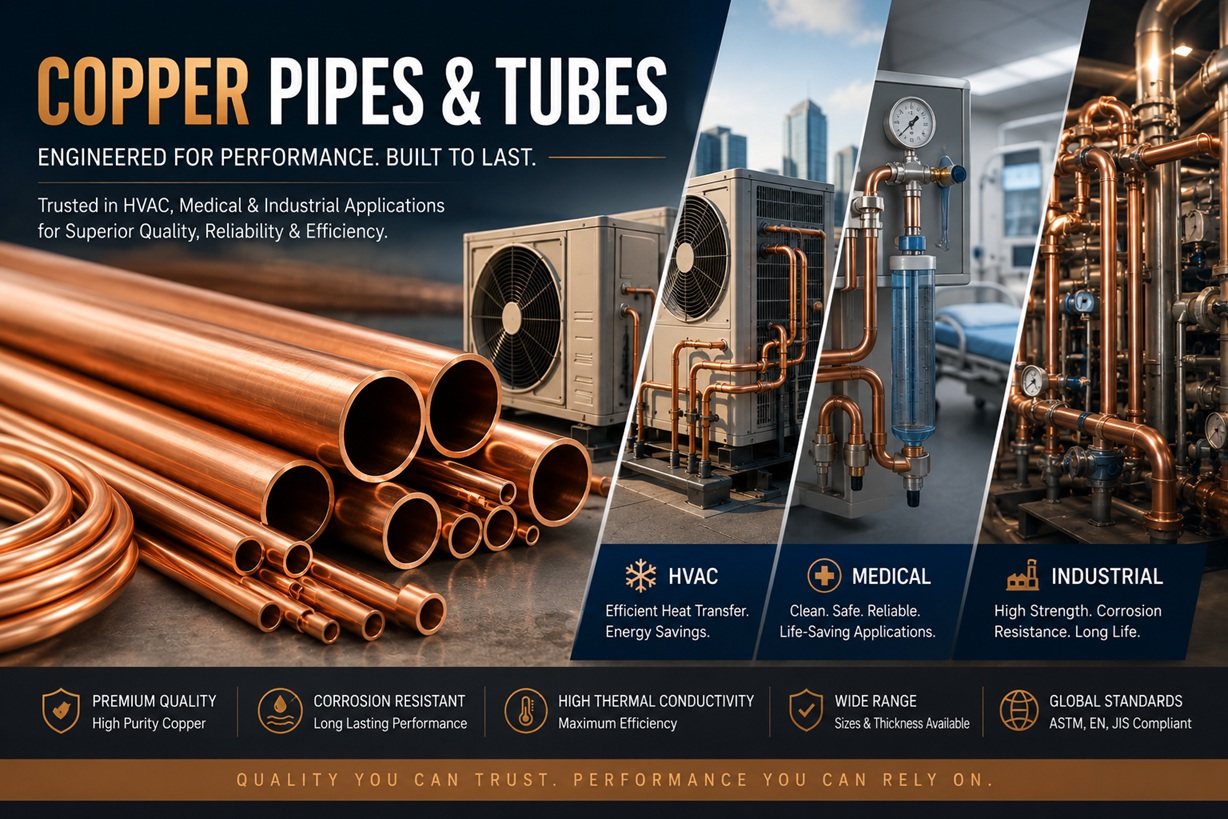
Copper Pipes & Tubes for HVAC, Medical Gas & Industrial Applications
Copper pipe and tube rarely mean just one thing. The material that carries refrigerant through an air conditioner isn't manufactured or certified the same way as the copper pipe running oxygen through a hospital wall, and neither is quite the same as the small-bore tubing carrying a pressure signal to an instrument panel on an industrial process line. Same base metal, very different requirements.
This guide works through copper pipe and tube by application: HVAC and refrigeration, medical gas, plumbing, gas and LPG/CNG service, instrumentation, and oil & gas with a focus on what actually changes between them: cleanliness standards, certification requirements, wall thickness, and jointing method. Understanding these differences is what separates a system that passes inspection and performs reliably from one that runs into problems down the line.
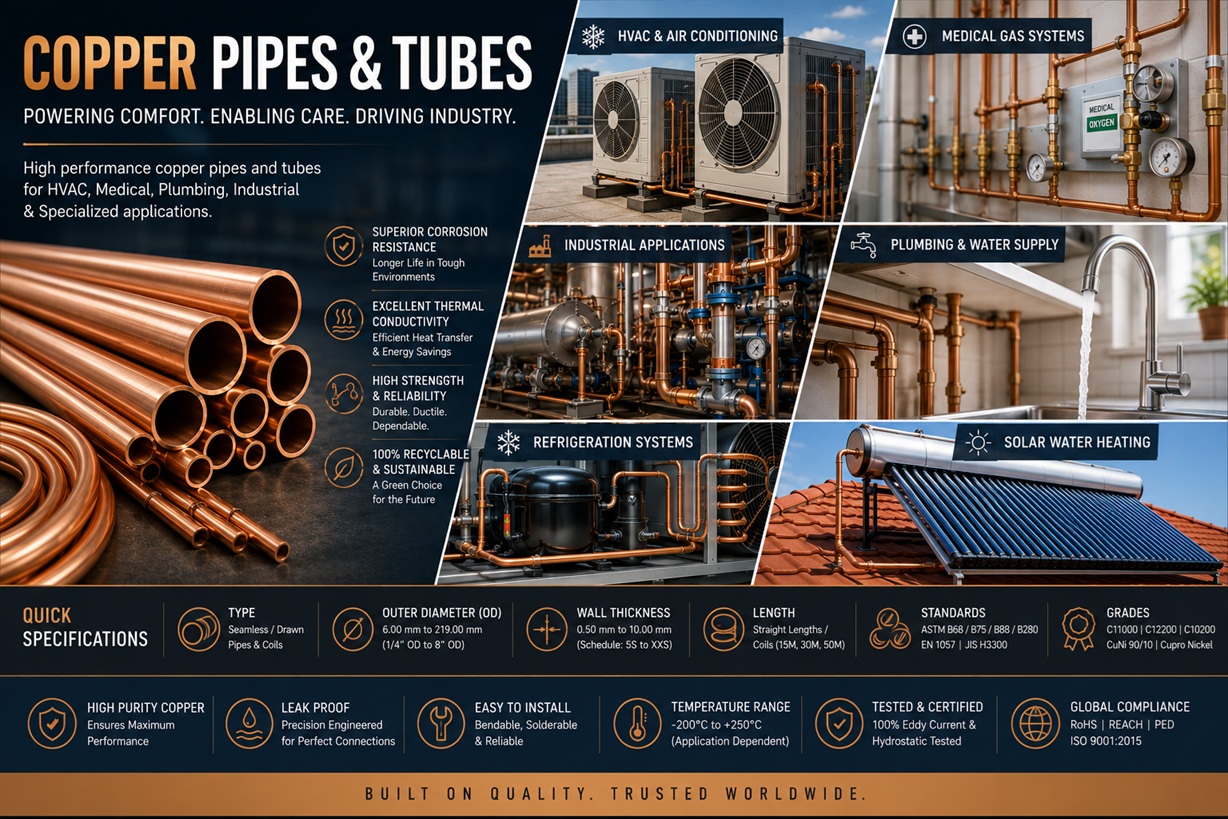
Why Application Matters When Specifying Copper Pipe
It's tempting to think of copper pipe as a single commodity product, but the application it's destined for changes several things about how that pipe needs to be manufactured, cleaned, and certified before it's fit for purpose.
Cleanliness requirements vary enormously. Refrigeration and medical gas applications demand internally cleaned, dehydrated, and sealed tubes, while general plumbing tube has no such requirement. Pressure rating and wall thickness shift depending on whether the system carries low-pressure water or high-pressure compressed gas. Certification and traceability requirements differ too: a medical gas system typically requires documentation and testing far beyond what a standard plumbing installation needs, often tied to healthcare facility codes rather than general plumbing codes.
Because these requirements aren't always obvious from the outside, two visually similar coils of copper tube can be manufactured to completely different standards. Confirming the intended application before ordering, rather than assuming general-purpose tube will work, is the single most important step in specifying copper pipe correctly.
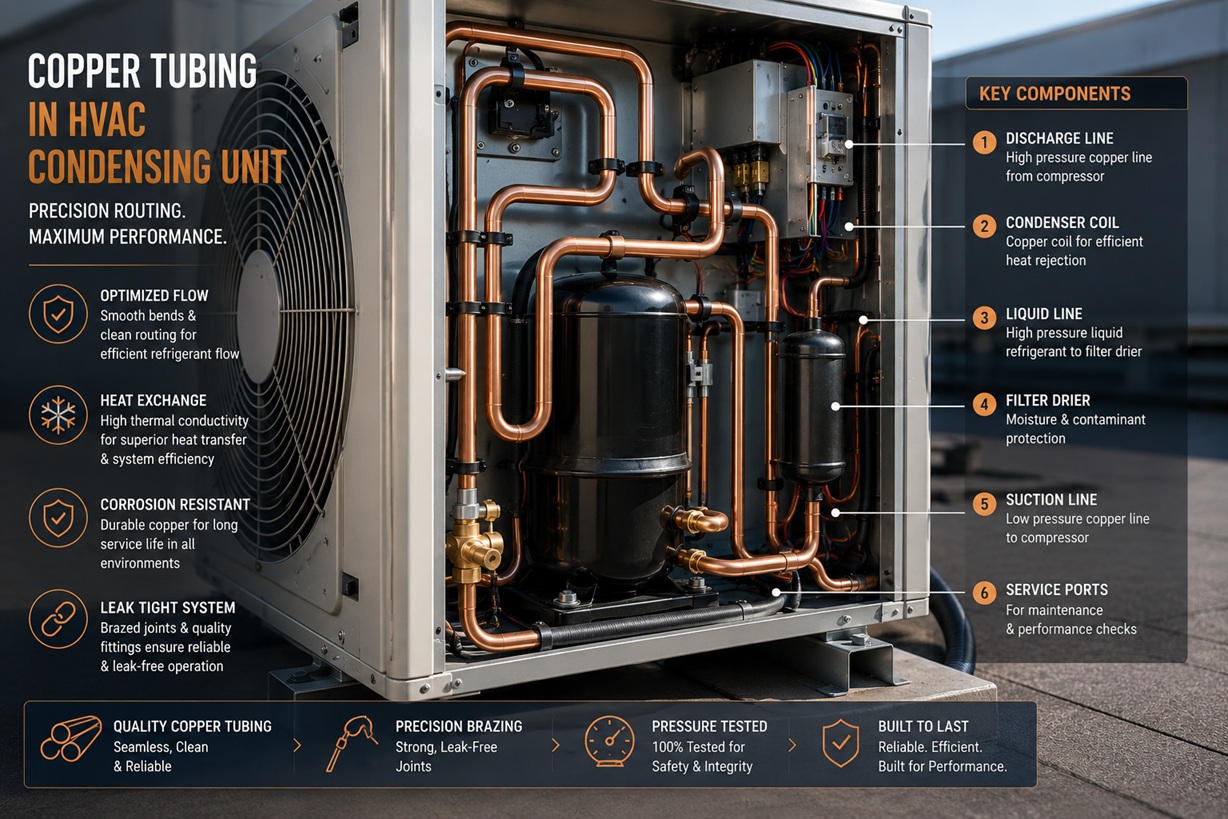
HVAC Copper Pipe & Refrigeration Copper Tubing
HVAC copper pipe is one of the most widely used applications of copper tubing, forming the circulatory system of air conditioners, heat pumps, and commercial refrigeration units.
Refrigeration copper tubing used in these systems is manufactured to standards like ASTM B280, which require the tube to be internally cleaned to remove oils and particulate residue, dehydrated to eliminate moisture, and capped or plugged at both ends before shipment. This matters because even a small amount of trapped moisture or contamination inside a sealed refrigerant line can cause ice formation, internal corrosion, or compressor damage once the system is charged and operating.
HVAC copper pipe is typically supplied in soft-annealed coils for field bending in residential split-system installations or in hard-drawn straight lengths for larger commercial systems where runs are longer and more rigid support is available. Installation almost always involves brazing rather than soldering, since refrigeration systems operate at higher pressures and temperature extremes than a soldered joint can reliably withstand over the system's service life.
HVAC Insulated Copper Tubing
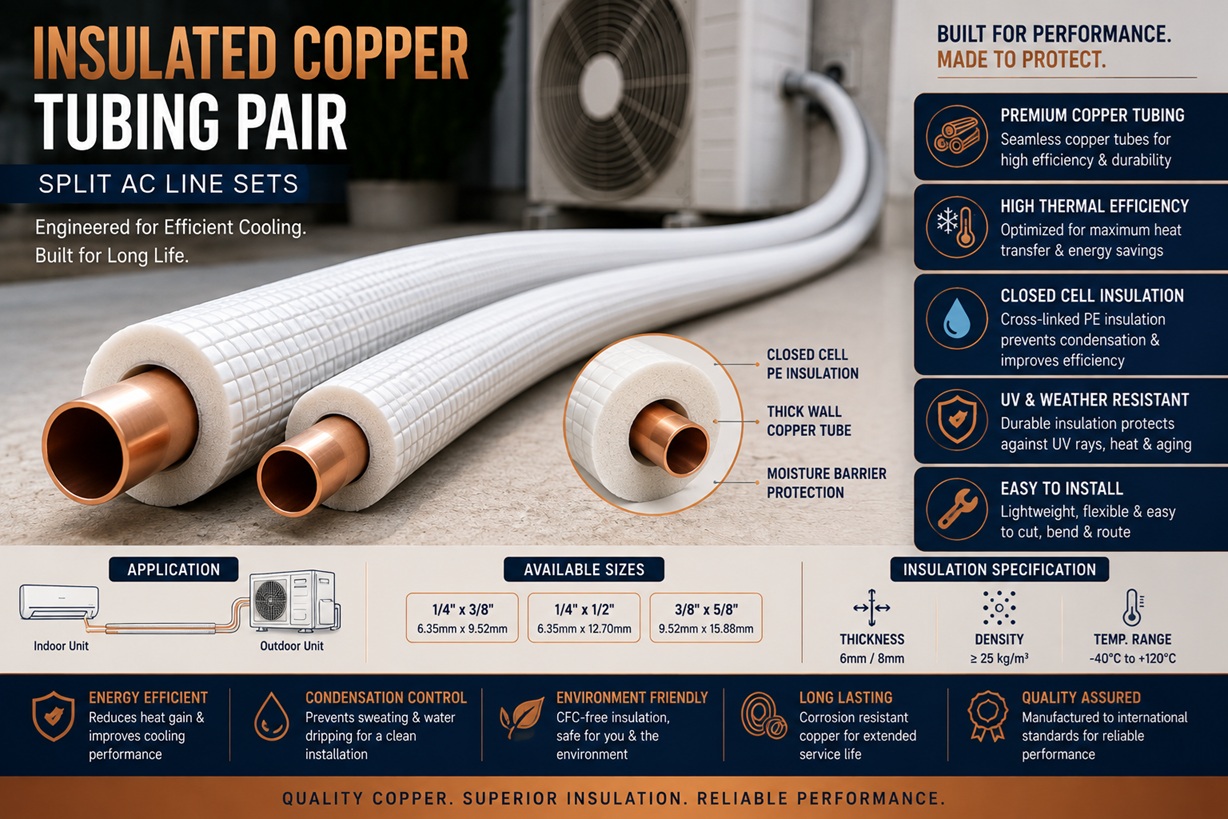
HVAC insulated copper tubing pairs a refrigerant-grade copper tube with a factory-applied thermal insulation layer, most commonly closed-cell foam, and it's a standard component in split air conditioning line set installations.
The insulation serves two purposes: preventing heat gain into the suction (low-pressure) line, which would otherwise reduce system cooling efficiency, and preventing condensation from forming on the tube's outer surface, which can drip, damage surrounding materials, or promote mold growth over time if left uninsulated. Line sets are typically supplied as a matched pair a liquid line and a suction line, pre-insulated and often bundled together for straightforward routing between indoor and outdoor units.
Specifying the correct insulation thickness for HVAC insulated copper tubing depends on the climate and the length of the run exposed to ambient conditions, since under-insulated tubing in a hot, humid environment can still experience meaningful condensation even with some insulation present.
Medical Gas Copper Pipe
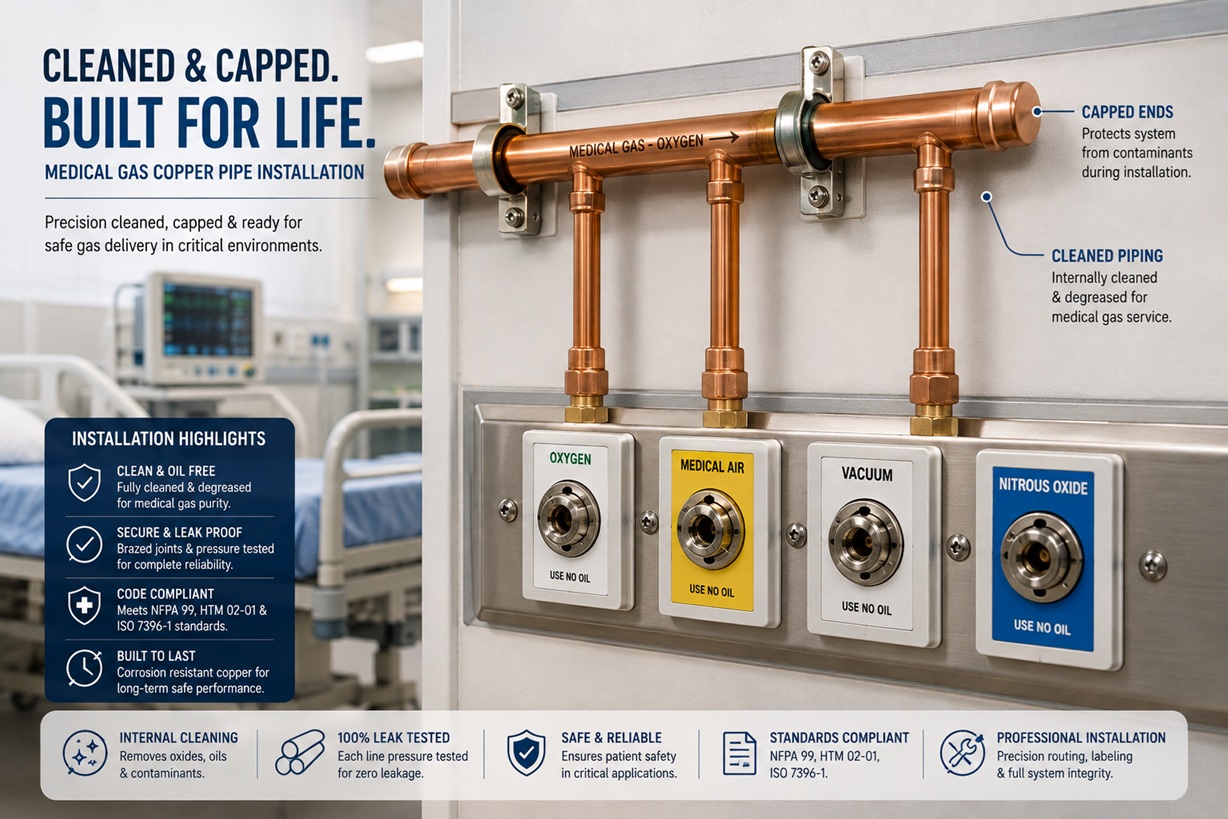
Medical gas copper pipe carries some of the strictest cleanliness and certification requirements of any copper piping application, for an obvious reason: it delivers oxygen, medical air, nitrous oxide, and other gases directly into patient care areas, where contamination or a system failure has immediate safety consequences.
Pipe intended for medical gas service is manufactured and cleaned to remove oils, greases, and particulate matter far more rigorously than standard plumbing or even refrigeration tube, since even trace hydrocarbon residue inside an oxygen line presents a fire risk under the highly oxidizing conditions medical oxygen creates. The tube is typically capped at both ends immediately after cleaning to maintain that internal cleanliness through storage, transport, and installation.
Beyond the pipe itself, medical gas piping systems are subject to extensive code requirements covering installation, brazing procedures (which must be performed by certified medical gas brazers using an inert gas purge to prevent internal oxide scale), pressure testing, and ongoing verification before a system is certified for patient use. Given the safety stakes involved, sourcing medical gas copper pipe specifically certified and documented for this application rather than substituting general-purpose tubing isn't a matter of preference; it's a baseline code and safety requirement.
Plumbing Copper Pipe
Plumbing copper pipe remains one of the most common and trusted materials for potable water distribution in residential and commercial buildings, prized for its corrosion resistance and long service life.
Manufactured to standards like ASTM B88 in Types K, L, and M, plumbing copper pipe is selected based on the pressure rating and mechanical durability a given installation requires Type K's thicker wall for underground service lines, Type L as the standard for most above-ground commercial and residential plumbing, and Type M for lighter-duty residential runs. Unlike refrigeration or medical gas tubes, plumbing copper pipes don't require the same internal cleaning and capping process since water systems don't carry the same contamination sensitivity as gas or refrigerant lines.
Joints in plumbing systems are most often made by soldering, which is well suited to the moderate pressures and temperatures typical of potable water service, though brazing and compression fittings are also used in specific circumstances, such as higher-temperature hot water lines or repair situations where heat isn't practical.
Copper Pipe & Tube for Gas Line, LPG & CNG Applications
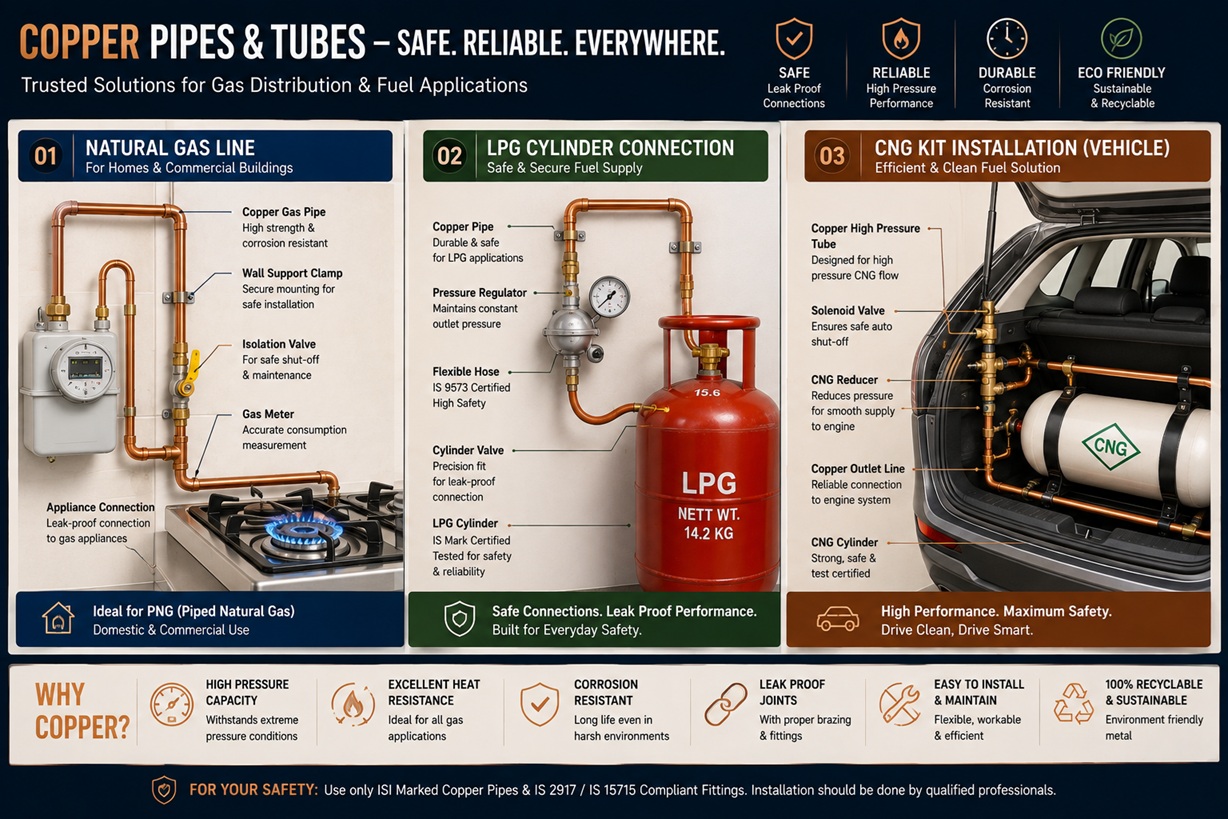
Copper's corrosion resistance and reliable jointing characteristics make copper pipe for gas line and copper tube for gas line applications a trusted choice across several fuel-gas contexts, though each comes with its own specific requirements.
For household and commercial piped natural gas, copper pipe for gas line service is manufactured and installed to strict cleanliness and pressure-rating standards, since a joint failure or undersized tube carries serious safety consequences. Most jurisdictions specify minimum wall thicknesses and require brazed rather than soldered joints for gas service, given the higher joint strength brazing provides.
Copper pipes for LPG applications introduce an added consideration: LPG can be more chemically aggressive toward certain fittings and seals than natural gas, so pipe, fittings, and jointing compounds all need to be rated specifically for LPG compatibility. Flexible copper tube is commonly used here to simplify routing from cylinders or bulk tanks to appliances, reducing the number of rigid joints exposed to vibration and handling.
Copper pipe for CNG kit applications used in compressed natural gas vehicle conversions operate under significantly higher pressures than household gas lines, meaning the pipe specified must meet automotive and pressure-vessel-adjacent safety standards, typically with thicker walls and more rigorous testing than standard gas pipe. Given that CNG systems are mobile and subject to vibration, heat cycling, and mechanical stress, using pipe specifically rated and tested for CNG service is a non-negotiable safety requirement rather than a specification preference.
Copper Pipe & Tube for Instrumentation
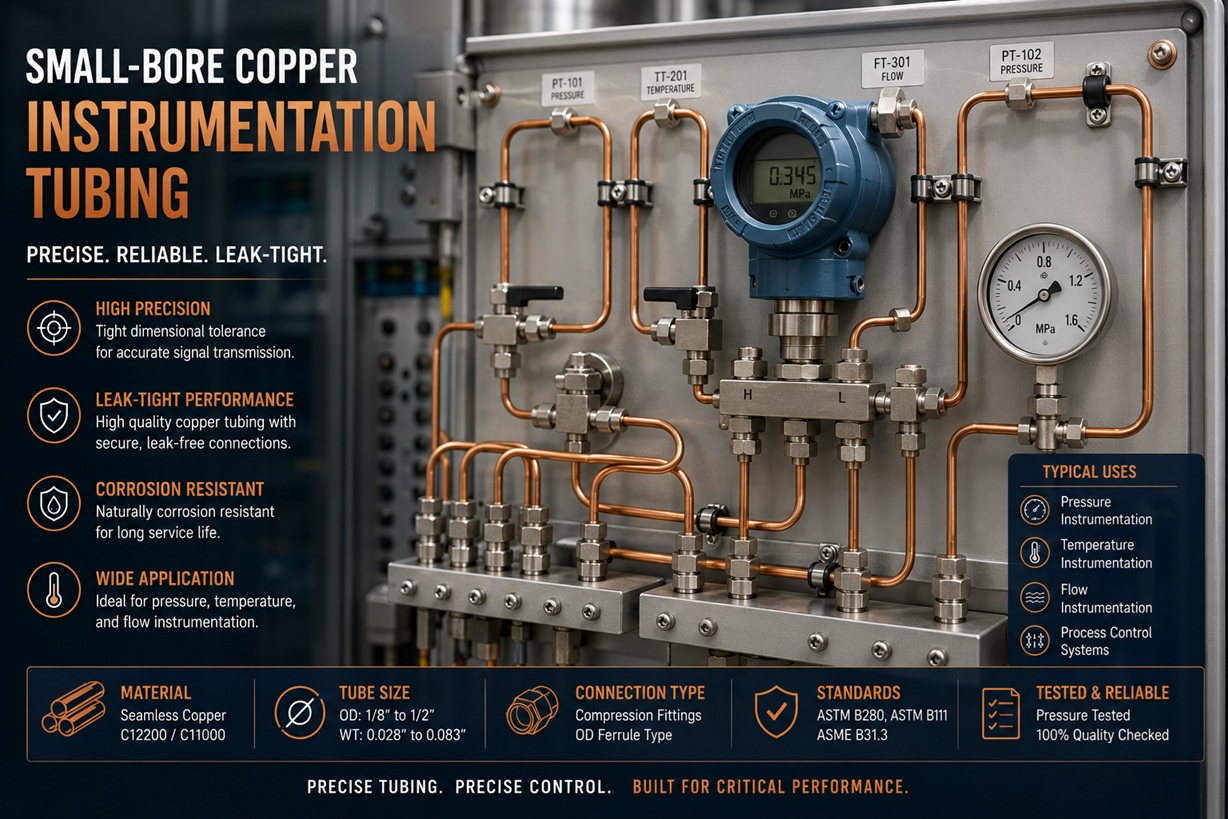
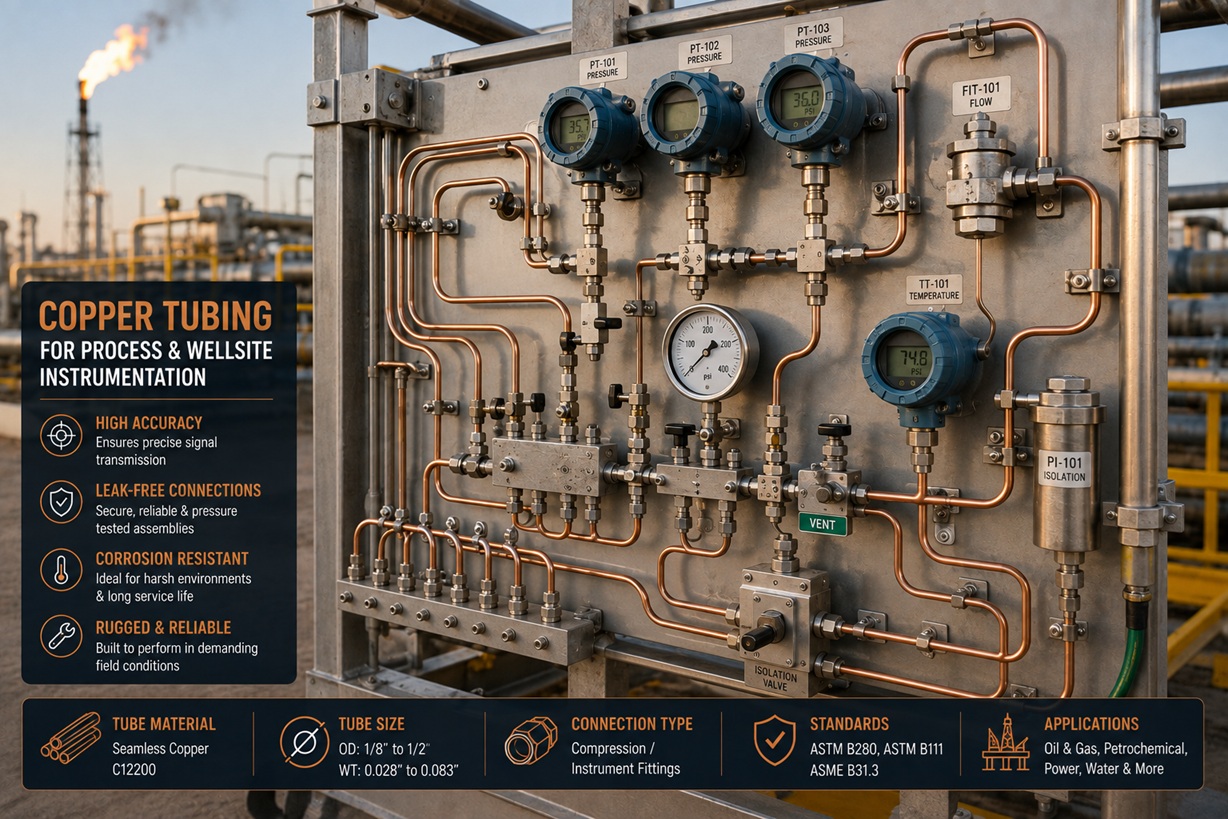
Copper pipe for instrumentation and copper tube for instrumentation cover a very different use case from the applications above: small-bore tubing used to carry pressure, temperature, or process signals between instruments and control systems in industrial facilities.
Instrumentation tubing is typically thin-walled and small in diameter compared to process piping, selected for its combination of corrosion resistance, ease of bending into precise routing configurations around control panels and equipment skids, and compatibility with compression-style instrument fittings that allow for tool-only assembly and disassembly during commissioning or maintenance.
Because instrumentation tubing often carries process fluid or gas at meaningful pressure directly to sensitive instruments, dimensional consistency and internal cleanliness matter for accurate signal transmission and to avoid contaminating sensitive measurement equipment. Instrumentation tubing runs are also frequently bundled and routed in dense configurations across control panels, which places a premium on tube that bend cleanly without kinking or work-hardening prematurely.
Copper Tubing for Oil & Gas Applications
Copper tubing for oil & gas applications spans a range of uses across upstream, midstream, and downstream facilities, generally centered on instrumentation, control, and auxiliary process functions rather than primary hydrocarbon transport, which is typically handled by steel piping.
Within these facilities, copper tubing carries hydraulic control fluid to actuated valves, connects pressure and temperature instrumentation to process equipment, and in some cases serves auxiliary cooling or utility functions around compressors and other rotating equipment. The corrosion resistance and reliable jointing copper offers make it well suited to these supporting roles, particularly in facilities exposed to humid or corrosive coastal and offshore environments.
Given the demanding environments oil & gas facilities often operate in vibration from rotating equipment, wide temperature swings, and exposure to process chemicals, copper tubing specified for these applications is typically selected with attention to both mechanical durability and compatibility with the specific fittings and instruments it will connect to.
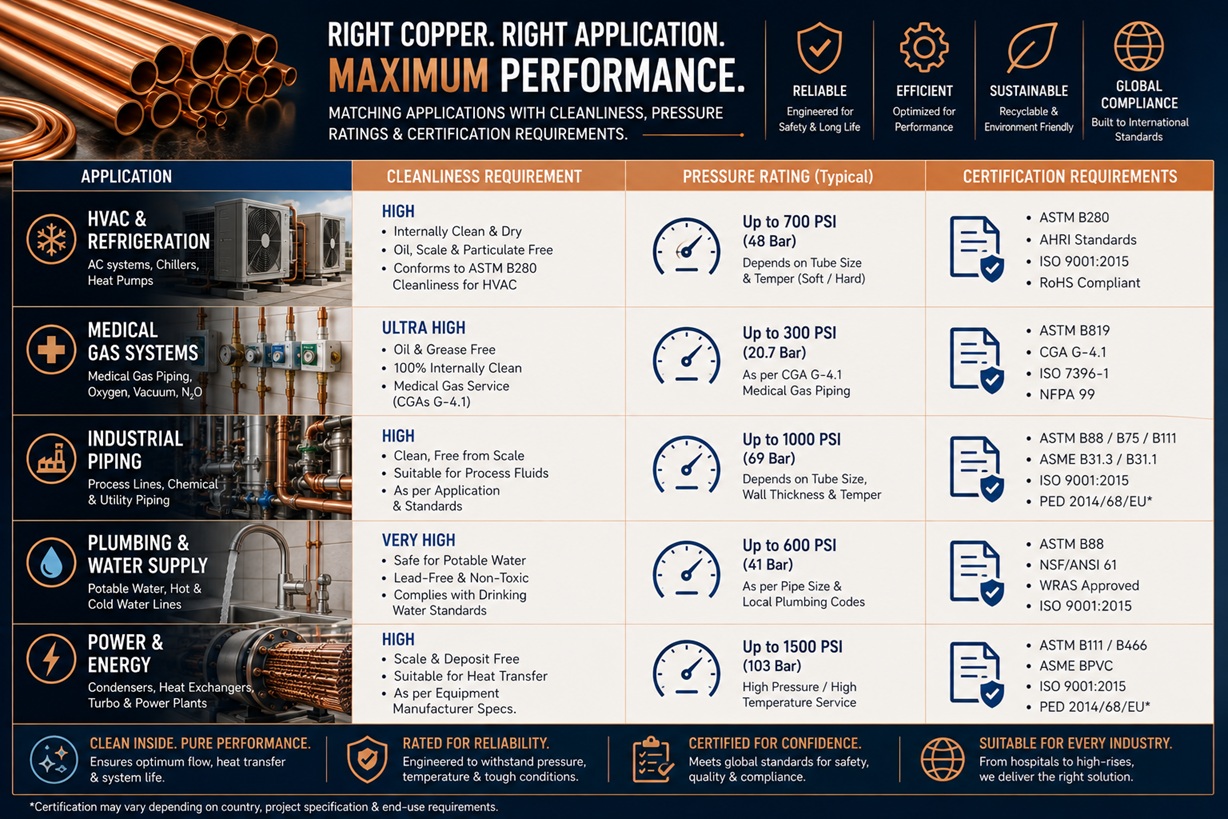
Matching Cleanliness & Certification to the Application
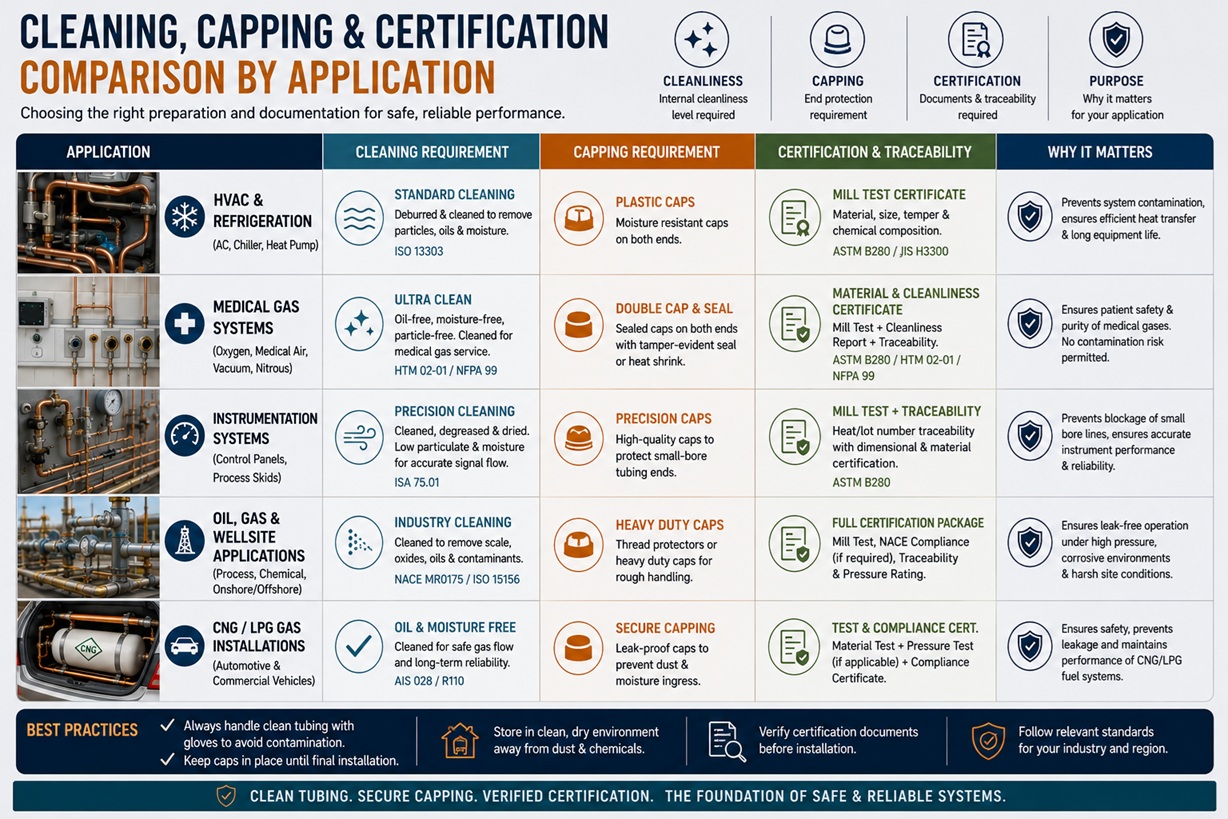
Looking across all of these applications together, a clear pattern emerges: the further a copper pipe or tube's contents move toward being safety-critical, pressure-sensitive, or contamination-sensitive, the more rigorous the manufacturing, cleaning, and certification requirements become.
General plumbing sits at one end of this spectrum, with relatively straightforward cleanliness requirements. Refrigeration and HVAC tube sits further along, requiring internal cleaning, dehydration, and sealed ends. Gas, LPG, and CNG applications add pressure-rating and brazing requirements tied directly to safety codes. Medical gas pipe sits at the far end, with cleaning, capping, and installation requirements governed by healthcare facility codes specifically because the consequences of contamination or failure are most severe.
Recognizing where a given project falls on this spectrum and specifying pipe manufactured and certified accordingly, rather than defaulting to whatever tube happens to be on hand is the practical takeaway that applies across every application covered in this guide.
Sourcing from an Industrial Copper Tubing Supplier
Because application-specific requirements vary so significantly, working with an industrial copper tubing supplier experienced across multiple application areas rather than a general commodity supplier makes a meaningful difference in avoiding specification errors.
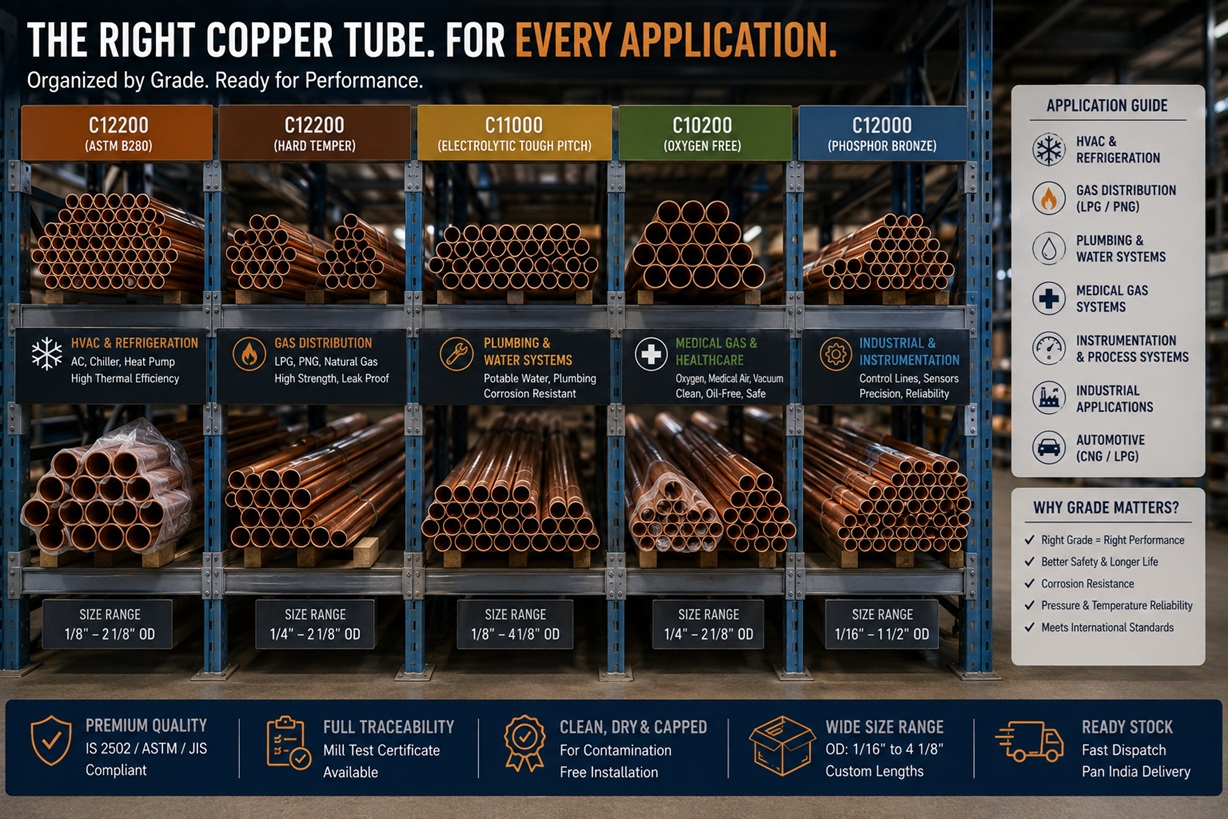
A supplier with genuine depth across HVAC, medical gas, plumbing, gas/LPG/CNG, instrumentation, and oil & gas tubing should be able to confirm which standard and cleaning process applies to a given project, provide mill or product certification appropriate to that application, and maintain consistent stock across the range of sizes and tempers each use case requires. This matters particularly for medical gas and gas-service applications, where certification documentation isn't optional paperwork but a requirement for code compliance and inspection.
For projects spanning more than one application area a hospital renovation involving both medical gas and standard plumbing, for instance, or an industrial facility needing both instrumentation tubing and HVAC tube for its own building systems consolidating sourcing with a supplier who understands the distinctions between these applications reduces the risk of a mismatched or incorrectly certified product ending up in the wrong system.
Frequently Asked Questions
Can the same copper pipe be used for both plumbing and refrigeration? Generally no refrigeration and HVAC copper pipe must be internally cleaned, dehydrated, and sealed at both ends, requirements that standard plumbing copper pipe doesn't need to meet, so the two shouldn't be substituted for one another.
Why is medical gas copper pipe held to a stricter standard than other applications? Because it delivers oxygen and other medical gases directly into patient care areas, medical gas pipe requires rigorous internal cleanliness (particularly removal of hydrocarbon residue, which presents a fire risk with oxygen) along with certified brazing and testing procedures governed by healthcare facility codes.
What's the difference between copper pipe for gas line and copper pipe for LPG? Both require pressure-rated pipe and brazed joints, but LPG applications need pipe, fittings, and jointing compounds specifically rated for LPG's chemical compatibility, since it can be more aggressive toward certain materials than natural gas.
Is copper pipe for CNG kits the same as standard gas line pipe? No CNG kit applications operate at significantly higher pressures than household gas lines and require pipe meeting automotive and pressure-vessel-adjacent safety standards, typically with thicker walls than standard gas pipe.
What makes instrumentation tubing different from standard copper tube? Instrumentation tubing is generally thin-walled, small-bore, and selected for clean, kink-free bending around control panels and compatibility with compression-style instrument fittings, rather than for carrying high-volume flow.
Why is HVAC insulated copper tubing used instead of bare tube? Insulation prevents heat gain on the suction line (protecting cooling efficiency) and prevents condensation from forming on the tube's exterior, which could otherwise drip or promote mold growth over time.
How do I know which application standard applies to my project? Confirm the intended use (plumbing, refrigeration, medical gas, fuel gas, instrumentation, or industrial process) with your supplier before ordering, since visually similar copper tube can be manufactured and certified to very different standards depending on application.
Conclusion
Copper pipe and tube perform reliably across an unusually wide range of applications, but only when the specific requirements of each cleanliness, pressure rating, certification, and jointing method are matched correctly to the job at hand. From HVAC copper pipe and refrigeration tubing, to medical gas pipe held to the industry's strictest cleanliness standards, to gas, instrumentation, and oil & gas tubing, understanding these distinctions is what separates a system that performs safely for decades from one that runs into avoidable problems.