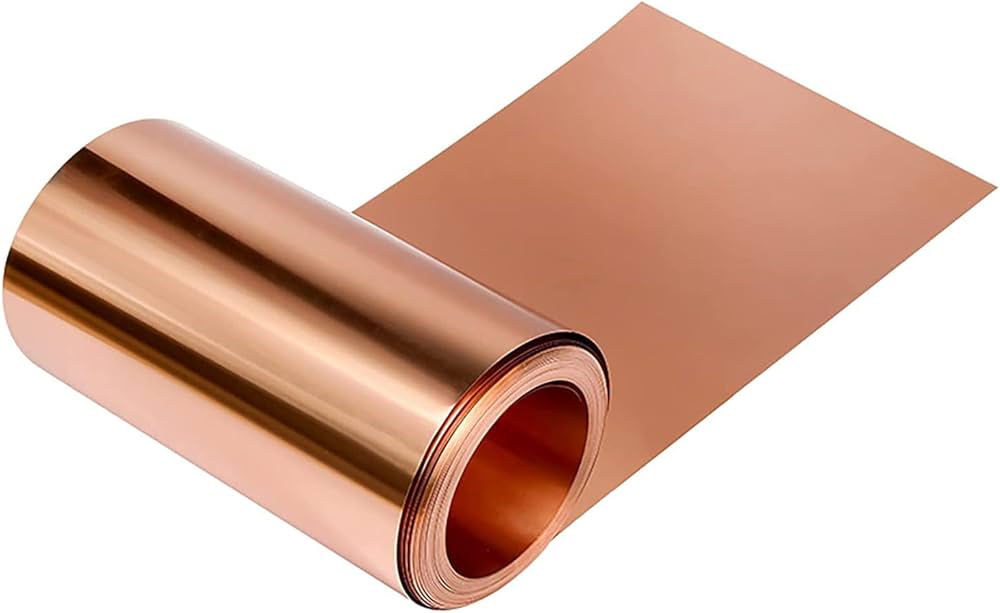
Copper Strips – Specifications, Grades, Standards and Industrial Applications
Copper strips are flat-rolled copper products supplied in straight lengths or coils and are widely used in electrical, electronics, power distribution, industrial fabrication, marine and renewable energy applications. Known for their exceptional electrical conductivity, thermal performance and formability, copper strips are essential materials for precision-engineered components and high-performance systems.
Manufactured from high-purity copper grades and produced under strict quality control, copper strips provide consistent thickness, smooth surface finish and reliable performance in applications where conductivity, durability and dimensional accuracy are critical.
Material Properties of Copper Strips
Copper strips offer outstanding electrical conductivity, typically exceeding 99.9% purity in electrolytic grades. This ensures minimal energy losses in current-carrying applications and excellent heat dissipation in thermal systems.
The high ductility and malleability of copper allow strips to be easily bent, stamped, punched and formed without cracking, making them ideal for complex electrical and industrial components.
Grades of Copper Used for Strips
Copper strips are manufactured using various grades depending on application requirements:
- C11000 – Electrolytic Tough Pitch (ETP) Copper
- C10200 – Oxygen-Free High Conductivity (OFHC) Copper
- C12200 – Phosphorus Deoxidized Copper
- C10100 – Oxygen-Free Electronic (OFE) Copper
Grade selection depends on conductivity needs, welding or brazing requirements and environmental conditions.
Manufacturing Process
Copper strips are produced through hot rolling or continuous casting followed by cold rolling to achieve precise thickness and width. Intermediate annealing processes are applied to control hardness, grain structure and mechanical properties.
Final finishing processes ensure smooth surfaces, uniform edges and tight dimensional tolerances suitable for electrical contact and precision fabrication.
Standards and Specifications
- ASTM B152 – Copper sheet, strip and plate
- ASTM B187 – Copper bar, bus bar and shapes
- EN 1652 – Copper and copper alloy sheet and strip
- EN 13601 – Copper busbars and profiles
- JIS H3100 – Copper and copper alloy strips
- IS 1897 – Copper strips and flat sections
Sizes and Dimensional Range
Copper strips are available in thicknesses typically ranging from 0.05 mm to 6 mm and widths from 5 mm up to 600 mm depending on manufacturing capability and application requirements. Strips can be supplied in coil form or cut-to-length sheets.
Custom widths, tight tolerances and special edge conditions are commonly supplied for electrical OEMs, electronics manufacturers and industrial fabricators.
Surface Finish and Condition
Copper strips can be supplied in various surface finishes including mill finish, bright finish and tinned finish. Tinned copper strips provide enhanced corrosion resistance and improved solderability, especially in electrical and marine environments.
Strips are available in annealed (soft), half-hard or hard conditions to suit different forming and mechanical requirements.
Applications of Copper Strips
Electrical & Electronics
- Electrical connectors and terminals
- Busbar laminations
- Transformers and switchgear components
- Printed circuit board applications
Power & Renewable Energy
- Solar power busbar systems
- Wind energy electrical connections
- Electric vehicle charging infrastructure
Industrial & Engineering
- Precision stamped components
- Heat transfer elements
- Industrial machinery parts
Marine & Transportation
- Shipboard electrical systems
- Railway and automotive electrical components
Quality Control and Testing
Copper strips undergo rigorous quality checks including chemical composition analysis, electrical conductivity testing, dimensional inspection and surface quality evaluation. Mechanical properties such as tensile strength and elongation are tested to ensure compliance with applicable standards.
Strict quality assurance ensures consistent performance, long service life and reliability in critical electrical and industrial applications.
Advantages of Copper Strips
- Excellent electrical and thermal conductivity
- Superior formability and machinability
- High corrosion resistance
- Wide range of sizes and conditions
- Compliance with global standards
Conclusion
Copper strips are a fundamental material for electrical, electronic and industrial applications where conductivity, precision and reliability are essential. Their versatility, durability and ease of fabrication make them indispensable across modern infrastructure, energy and manufacturing sectors.
Manufactured to stringent international standards and supplied in consistent quality, high-performance copper strips continue to support efficient energy transmission and advanced engineering solutions worldwide.